 USD
USD 
 INR
INR  GBP INR
  CAD INR USD INR GBP INR CAD INR
Indian Rupee is likely to touch 79.5 INR/1 USD in 2022.
The Indian Rupee has fallen to an all-time low against the US dollar, reaching levels of 1 USD to INR 76 in the recent past. UBS strategists expect the INR to weaken to 77 per dollar by the end of the year - more than 5% weaker than current levels - and depreciate further to 79.5 per dollar by September 2022.
If you are sending money to India from the US, a weaker rupee means more value for the same amount of dollars. Set up exchange rates alerts to get notified when the USD vs. INR reaches 79 rupees per dollar.
India received $83 billion in remittances in 2020, according to the World Bank. India is the top recipient of remittances globally, followed by China, Mexico, and the Philippines. Despite the worrying forecast, remittances to India continue to out-perform. Compare multiple money transfer specialists before sending money from the US to India or from India to the US.
The fall of INR vs. USD is driven by several factors, including weak export numbers, a drop in domestic consumption, increased energy prices, and fear of soaring inflation, among other reasons.
Here are some of the major factors that have impacted the fall of the Indian Rupee against the US dollar:
The Current Account Deficit refers to the net amount of a nation's imports minus the exports during a year, also known as External Balance.
The Current Account Deficit is considered an important metric for gauging a country's economic health and stability. It gives you the difference between the inflow and outflow of foreign currency. A large trade deficit signals greater reliance on foreign capital inflows and further weakens the Indian rupee in the Forex market.
Even as all the economies in the world are going through an economic slump, an disproportionate trade deficit will result in creating a weak rupee value against the US dollar.
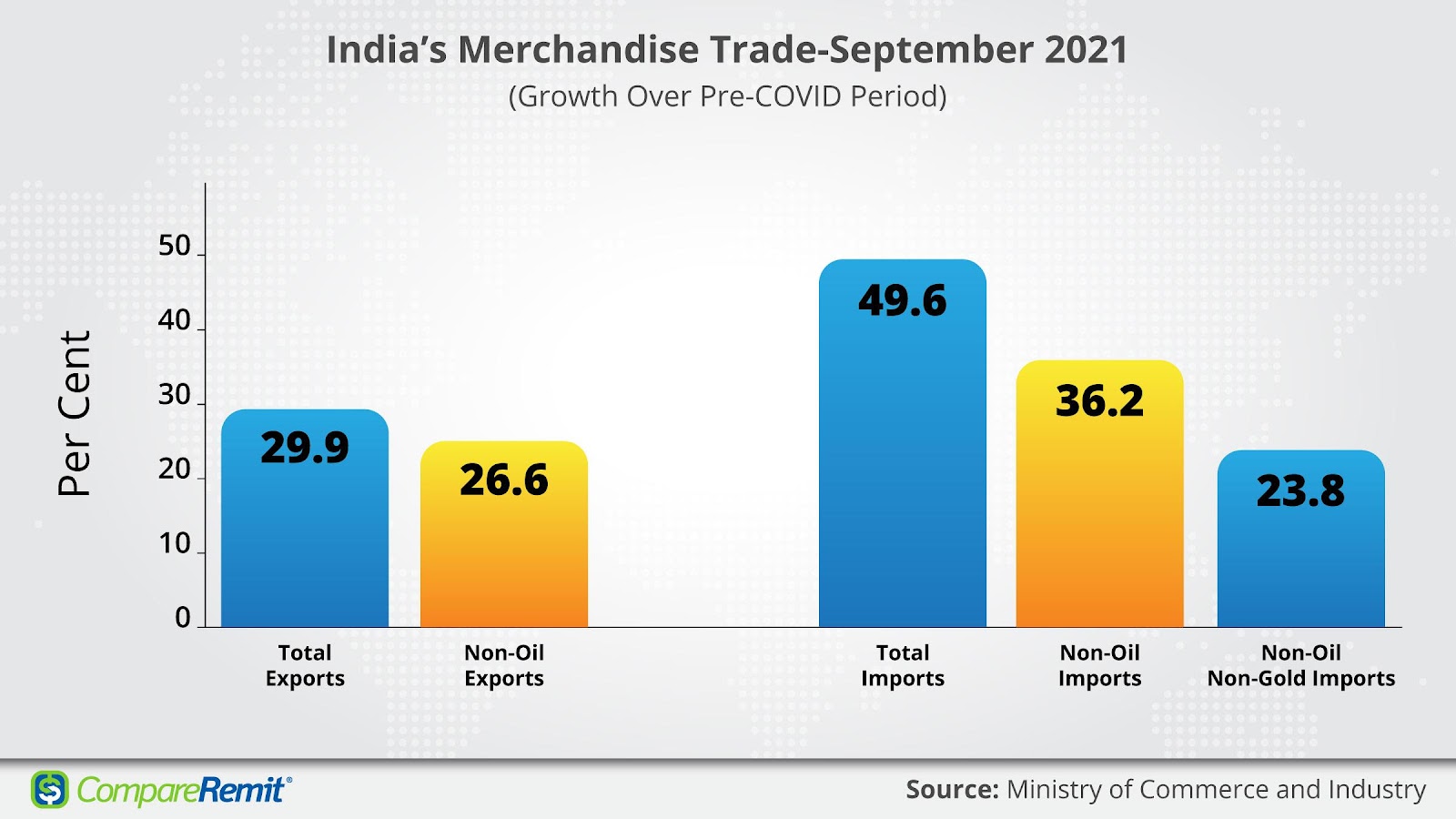
India's current account balance posted a surplus of $6.5 billion, which is 0.9 percent of Gross Domestic Product (GDP) in the first quarter of the financial year 2021-2022 (Q1: FY 21-22) as against a deficit of $8.1 billion, which is one percent of GDP in the fourth quarter of the financial year 2021-2022 (Q4: FY 21-22).
The current account surplus was $19.1 billion, which was 3.7 percent of GDP in the previous financial year (Q1:FY20-21) for the same period, according to the Reserve Bank of India (RBI).
Significantly narrower current account deficits than in the first half of the last decade, and foreign exchange reserves at historically high levels have strengthened India's external position and reduced its vulnerabilities to external shocks. However, it remains vulnerable to volatile global crude oil prices as approximately 45% of all imports are energy-related.
Given that net exports are projected to drag on growth over our forecast horizon, the current account deficit is likely to remain an important factor driving INR performance relative to USD over our forecast horizon.
India's current account deficit is expected to rise due to increased crude oil prices, expansionary fiscal policy, and low GDP growth.
Historically, the price of oil has been inversely related to the price of the U.S. dollar. The explanation for the relationship between oil prices and currencies is based on two primary factors:
To trade crude oil, countries around the world use barrels for units and USD in currencies. Post-Covid restrictions, as economies start their long journey to recovery, crude oil prices reached a 3-year high.
For a country like India that is highly dependent on crude oil imports, it has a negative impact on the Indian rupee against all major foreign currencies, especially against the USD.
When the USD is strong, you need fewer USD to buy a barrel of oil and vice-versa. India needs USD to buy crude oil, so a weaker rupee means you need more rupee to the same amount of USD and barrel of crude oil. Therefore, when the INR falls against the USD, these import costs rise.
As a net importer of oil, INR has a huge impact caused by any fluctuation in USD and crude oil prices.

The first question that comes to our mind is - what is the relationship between interest rates and exchange rates?
Let's understand the definition of both interest rates and exchange rates before we explain how it impacts USD vs. INR.
Interest is the amount a lender charges to a borrower as a portion of the loan given by the lender, usually expressed as a percentage for a particular period of time.
The foreign exchange rate is the value of one currency in relation to another. The relationship is stated as Currency 1/Currency 2, such as USD/INR, where the exchange rate shows the price of the USD in relation to INR.
For investors, a high-interest rate means a higher return vis--vis other currencies. To take advantage of the yield, investors will most likely move their investments* to countries with higher returns, which will increase the demand for the currency and further strengthen it vis--vis other currencies.
*Investments with a forward cover to protect returns in absolute terms
Amid the inflationary pressure, the Federal Reserve is looking at interest hikes as a measure. This will, in return, have an impact on all USD currency pairs, including USD/INR.
Keep in mind that beyond the US, interest rate differences between India and other emerging markets beyond the US could also have additional pressure on INR.
Other major factors that impact the interest rates are central banks' policies, financial system, government spending, unemployment rates, and inflation.
A Fiscal Deficit is defined as a net negative in the government's income compared with its spending. A fiscal deficit is usually calculated as a percentage of GDP or total amount spent in excess of income.
Current Fiscal Deficit is when the government borrows more money to fund expenses instead of collecting revenues from taxes and other sources. This leads to a decline in total tax revenue, which could impact economic growth.
The Current Fiscal Deficit is considered a leading indicator of a country's creditworthiness. When there is a spike in the Current Fiscal Deficit combined with negative exports growth, it may indicate that an economy may be entering a recession, and a higher cost of borrowing is guaranteed.
A deterioration of the current fiscal deficit can happen for many reasons. It might simply reflect lower tax revenues due to weak economic conditions. Alternatively, it could also mean that governments are taking advantage of low-interest rates to increase spending.
To reduce the deficit, the government needs to decrease spending and increase income. In any case, a spike in fiscal deficit has a negative effect on USD vs. INR.
In conclusion, USD and INR are both floating exchange rates, meaning that a currency price of a nation is set by the supply and demand relative to other currencies in the Forex market. However, central banks have various measures to intervene to keep a check on a free-falling or a spike in their exchange rates.
Central bank interventions through buying and selling of foreign currencies and setting new interest rates for the country to bolster export competitiveness, help increase foreign exchange earnings, and shore up reserves.
Regardless of the steps to stabilize its currency, its fortunes are tied to external factors. The continued weakness in domestic demand growth is likely to keep pressure on INR. Further selling pressure on INR is likely amid rising crude oil prices and a widening trade deficit.
If you send remittances regularly, we recommend using a money transfer specialist who offers the highest exchange rates.


 60755 Vistas
  Take advantage of the historical USD to INR exchange rates!


