USD INR ₹ 94.58
GBP INR ₹ 124.71
CAD INR ₹ 65.20
Articles

Best Ways To Send Money From Euro To USD

Updated on August 12, 2021 10:26 am
Woman handing Euro and Dollars to a man

For sending money from Europe to the United States or vice versa or anywhere internationally, many of us are inclined to approach a bank whether we want to send the money for business or personal reasons.

Banks may seem like an easy option but it is not the most cost-effective and convenient. When compared to specialized money transfers service providers, banks often lack tools and products for a streamlined transfer process, provide poor exchange rates (margin up to 5%), charge huge fees (up to $30 or more), have a longer delivery period, and in many, they have hidden fees.

In this day and age, the traditional way of international money transfers via banks is being challenged by highly competitive international money transfer specialists whose sole purpose is to facilitate money transfers with lower costs, faster speed, and enhanced convenience.

Today, international money transfers are almost instant at the touch of a few buttons, no matter where you are in the world. You can send money online securely or through mobile apps without needing to leave the comfort of your home. 

There are several money transfer companies to choose from, each offering competitive exchange rates, low transfer fees, faster transfer speed, different payment methods, and more. Whatever the reason for sending money overseas, it is best to consider your options and choose the best service for your specific needs.

Before we list the top options for your EUR/USD transfers, here are 5 important things you need to consider to find the best way for you to transfer money internationally.

IjmT0y1plBNGMnrasNr1tIAqgATCYlIIzJUtU_XSDp2ypO3QoSMgVY0K4qo5S6GKfdqeN5fDkZOliUWuSuzdAaIpKnWbnCqbmTBPg2r-dtsatFrMLuUynnCRclVif1kqbQF2JSQ


Exchange Rates

Getting the best exchange rates will get you the best value for your money since it affects how much money is received at the other end. The foreign exchange market is highly volatile and the rates can fluctuate constantly. That is why timing your transfer will make a huge difference. A favorable exchange rate on large transfers particularly can save you a significant amount of money.

Fortunately, there are online tools that can help you set alerts for your preferred exchange rates. Some providers allow you to fix exchange rates if you need to make regular payments in the future through a Forward Exchange Contract. 

Most upscale banks add a 5%-7% margin on the mid-market exchange rate (the rate you see in Google/Reuters) when converting from one currency to the other (in this case, from EUR to USD). On the other hand, money transfer specialists offer a more competitive rate which is a better option. They offer value for money, added convenience, and also peace of mind for the future. 

Fees

Fees can make international money transfers expensive. The fees vary widely between money transfer providers: it can be fixed, free, or a percentage of your transfer amount. It will also depend on the pay-in and pay-out method, the speed, the destination country to name a few factors.

Also, be aware that a zero-transfer fee doesn't necessarily mean you will save money. In such cases, the exchange rate can be very low. Conversely, an attractive exchange rate can come with a higher transfer fee. 

Be mindful of hidden fees so that you don't end up losing money without your knowledge and your recipient receives less money than you intended to send. 

Speed

Transfer speed is another factor that needs to be taken into account when choosing a service provider. Transferring money overseas can take place within a few seconds, minutes, a few hours, and even more depending on several factors such as the currencies used, destination country, payment method, bank holidays, time zones, etc. The cost of the transfers will also vary with how fast and slow the money is being sent.

Cash transfers are usually instant while it will cost a little extra when compared to bank wire transfers which can take 1-5 business days. In case of an emergency where you need the money to send in an instant, high-speed transfer matters. If you are not in a hurry, the less expensive option lets you save money. 

Security 

With money transfer companies becoming a popular alternative to banks, it is worth checking the company's reputation by reading online reviews before engaging with any money transfer specialists.

You will have to make sure that they are authorized by appropriate financial authorities such as FCA (Financial Conduct Authority), FinCEN (Financial Crimes Enforcement Network), FINTRAC, or any other regulatory body to carry out money transfers in the country they operate and that your money is safe via secure encryption methods.

Proper research and awareness can protect you from becoming a victim of money transfer scams.

Customer Service 

An efficient customer service team is very handy when you need assistance during the transfer process. A dedicated team should be able to resolve any issues with transfers from initial account set-up to the receipt of money by the recipient. 

Make sure the money transfer company you choose has a reputable customer service record. There can be many instances where you need to speak to the support team for guidance and to put your mind at ease if you are not familiar with sending money overseas. It can be complicated and confusing at times without a guide.
Top 3 Best Ways To Send Money Online From Europe To The U.S.

Ir5yp1lpnMmrWvnEmUNHdUC0gRlyNd0GirIok5Ubpu7Nt4FmQ9THIGGg8EerCD6-FDqgsSPRlj91eIor7vgCuagRYqyXZjdbdsPRxvHDoTIY1wrfRLB1jWPBYG1zM4JfMx1dlRA


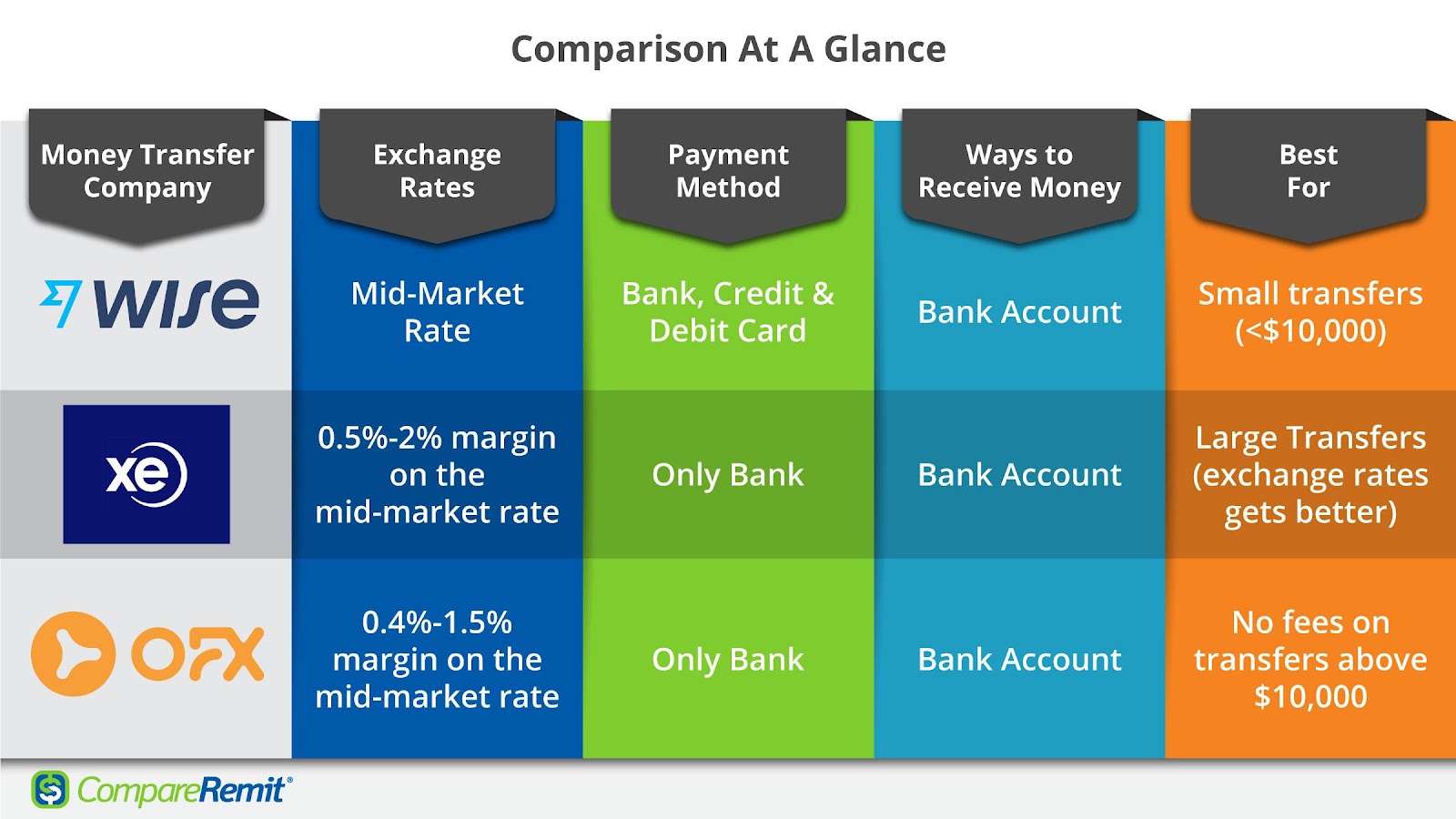
Wise (formerly TransferWise): Best Exchange Rates For Small Transfers

Wise with a valuation close to $11 billion is a London-based financial technology company, popularly known for providing one of the cheapest money transfer services globally, especially if you are sending small amounts. For larger transfers (more than $10,000) a specialist foreign exchange provider can be a little cheaper.

Wise is among the few companies that offer the mid-market rate and have transparent fees. Their fees depend on how fast you want the transfer to be, the transfer amount, how are you paying, and which currencies are being used.

You can pay with your bank account, debit card, or credit card. The cheapest is direct bank debit or ACH, followed by bank wire transfer, debit, and credit card.

Since Wise only offers bank-to-bank transfers, your recipient will need to have a bank account in the U.S. But the services they offer are much cheaper than the traditional bank transfer services. You also get access to a multi-currency account and a Mastercard debit card. There are services for both businesses and individuals.

It is regulated by multiple financial authorities including FCA in the UK and FinCEN in the U.S. and other agencies around the world. Wise uses the latest encryption technology to safeguard your money.

It is extremely easy to create an online account or you can download Wise's mobile app for Android and Apple iPhones. You will need to provide the recipient's details including their bank details. The transfer can take anywhere from minutes to a few days.

Wise has a Trustpilot rating of 4.6 out of 5 which is one of the best. 

XE: Best Exchange Rates For Large Transfers 

XE is a Canada-based online foreign exchange company that offers international money transfers to over 170 countries in more than 60 currencies. It is a trusted and reliable money transfer service provider with low fees.

XE charges no transfer fee but puts a small mark-up (in the range of 0.5%-2%) on the mid-market exchange rate. Most importantly, you get better exchange rates with larger transfers, which means the margin gets smaller as the transfer amount increases. Once you are all set to transfer, you will be able to see the exchange rate offered for that particular transfer.  

There is no limit on the transfer amount with XE. You can send up to $500,000 or currency equivalent online. You can get in touch with their currency experts to guide you through the transfer process for larger transfers. 

You can transfer money on their website or mobile app after setting up an account and providing the necessary information like recipient details, transfer amount, etc. You can only pay through a bank account. There is no card option. The majority of the transfers are completed in a day although they can be delayed due to certain factors. You can track the transaction online.  

Trustpilot rating is 4.5/5 with over 46,000 reviews.


OFX: Fee-Free Online Transfers

OFX, an Australia-based online foreign exchange company has been in the money transfer business for more than 20 years providing money transfer services to over 190 countries, in over 55 currencies. It has a wide banking network, physical offices spread across the world, and is monitored by over 50 regulators globally.

With OFX, customers can send money online with no fees on transfers over $10,000. For smaller transfers below $10,000, a flat fee of $15 is charged. Do keep in mind that OFX does have a minimum transfer amount of $1,000. So it is not ideal for users sending smaller amounts of money.

OFX makes money by putting a small margin on the mid-market exchange rate (usually 0.4%-1.5%) which is way lower than what banks charge. You can lock your preferred exchange rate for 24 hours.

Money transfers can be done via their online platform or mobile app. Sign up for an account with your personal details and set up for a transaction online. You can also check rates and track your transfers. 

Payment is to be done through a bank account, so your recipient needs access to a bank account to receive the money. The money typically arrives in 1-2 days but can take longer (3-5 days) with certain currencies. 

OFX offers excellent customer service which is available 24/7 both on phone and email. The advantage of having a global presence is that customers in different time zones don't have to worry about the absence of customer support at any point in time.

OFX has a Trust pilot rating of 4.3 out of 5.

Takeaway

There are several other options apart from our top 3 picks for EUR/USD transfers. The point is each of the options has both advantages and disadvantages. You will have to decide the best one according to your needs. It could be the speed, low fee, exchange rate, transfer amount, etc that will determine your choice.

A little research, planning, and comparing your options can get you the best deal for sending money overseas.

 19541 views
Rate article:
(5.0)
 
 
Money Transfer FAQ's
Related Articles
what-is-fiat-currency
Fiat Currency: What It Is and How It Affects Your Money

Fiat currency, in simple terms, is the government-issued national currency. In the United States of America (U.S.A.), the dollar is the fiat currency. It is the legal tender, meaning it is used by American citizens for daily transactions and is required for paying debts and federal taxes. Unlike earlier times, modern fiat currency is not backed by any physical commodity, such as gold or silver. Instead, its value depends on supply and demand, as well as the stability and credibility of the government and its central bank that issues it.So yes, the dollar derives its value from public trust in the government and the Federal Reserve, as well as the stability of the American economy.However, the downside of fiat currency is that, since it is not tied to gold, silver, or any other commodity, its purchasing power erodes during periods of inflation. And, needless to say, fiat currency loses value when citizens lose faith in their government.Examples of Nations Losing Trust in Their Fiat CurrencyWhen public confidence in a currency collapses, the effects ripple through an entire economy. Here are real-world examples of countries facing that breakdown.1. Zimbabwe (Late 2000s)This Southeast African nation printed truckloads of money to cover government spending, which triggered hyperinflation. Prices doubled almost daily, and at one time inflation hit over 231 million percent. Citizens needed wheelbarrows of cash to buy just a loaf of bread. Eventually, the Zimbabweans abandoned the Zimbabwean dollar and switched to the U.S. dollar and other foreign currencies. They even turned to a barter system for their daily transactions.2. Venezuela (2016–2019)Years of economic mismanagement and dwindling oil revenue in this South American country led the government to print huge amounts of money, triggering inflation. Gradually, inflation spiraled into hyperinflation, wiping out savings as prices skyrocketed. Many Venezuelans turned to U.S. dollars, barter, or crypto just to survive.3. Argentina (Perpetually in Crisis, Most Recently 2018–2023)Argentina, again in South America, has long faced chronic inflation due to its debt crises and loss of confidence in government policies. Citizens often prefer U.S. dollars for savings, leading to a thriving black-market exchange rate. Persistent public distrust in their fiat currency continues to weaken the Argentine peso.Why Do Countries Even Use Fiat Currency?1. It Offers FlexibilityCentral banks adjust interest rates and manage the money supply through monetary policy. This flexibility is a major advantage of fiat currency and helps them respond to shifting economic conditions.For example, during the 2008 global financial crisis, the U.S. Federal Reserve slashed interest rates to near zero and injected liquidity into the banking system. This rapid response was only possible because fiat currency allows central banks to expand the money supply when needed.Similarly, during COVID-19, countries like the U.S., India, Japan, and the U.K. issued large stimulus packages and emergency relief funds by expanding their money supply, something possible only with a fiat currency and not possible under a gold-backed system.2. It Helps Manage InflationBecause the central banks can control the supply of money (fiat currency) and thus overall liquidity in the economy, they can fight inflation by tightening the money supply. For example, the European Central Bank raised interest rates aggressively in 2022 when Eurozone inflation hit record highs. This move helped stabilize prices.3. It Supports Modern Banking and Credit SystemsFiat currency forms the backbone of the modern banking system. It enables commercial lending, credit cards, mortgages and business loans, interbank transfers, and digital and electronic payments. For example, India’s massive digital payments ecosystem, especially UPI, works because the rupee exists as fiat currency that can be digitally created, stored, transferred, and settled in banking systems.Similarly, banks worldwide can issue loans by creating new deposits. This credit expansion would be extremely difficult under a commodity-backed currency.4. It Helps Stimulate or Slow the EconomyGovernments, through central banks, can lower the interest rates and thus increase the supply of money into the economy during times of recession. On the flip side, during economic booms when inflation is going through the roof, it can increase the interest rates to reduce credit and money supply in the economy and thus fight bouts of inflation.For example, Japan kept interest rates near zero for decades to stimulate growth and avoid deflation. This long-term strategy is viable because fiat currency allows flexible monetary control.How Does Fiat Money Work? 1. Government Issues the CurrencyThe government declares the national currency as legal tender. In the U.S., the Treasury prints physical money, while the Federal Reserve oversees the monetary system.2. No Commodity BackingModern fiat money is not backed by gold, silver, or any other physical commodity. A dollar cannot be exchanged for gold at a fixed rate.3. Its Value Comes From Trust and StabilityFiat money has no intrinsic value. Its worth depends on public confidence, government stability, economic performance, and inflation levels.4. Legal Tender Status Creates Built-In DemandDollars must be accepted for purchasing goods and services, paying debts, if any, and paying federal taxes. This requirement guarantees widespread use of the U.S. Dollar, the fiat currency of the U.S.A.5. Central Bank Controls the Money Supply Through Monetary PolicyThe Federal Reserve (U.S. central bank) guides liquidity in the financial system, meaning it can increase or decrease the amount of money in circulation. The Federal Reserve uses tools like adjusting interest rates, open-market operations, and controlling bank reserves. These tools help manage inflation, unemployment, economic growth, and recession recovery. How Can You Track Exchange Rates Smartly? If you send money abroad or deal with foreign currency, fluctuations in fiat exchange rates directly affect how much your family receives or how much your international transfers cost.This is where a platform like CompareRemit is incredibly useful. It lets you compare real-time exchange rates, transfer fees, and provider speeds in one place, helping you get the best value for your money instead of losing out to poor rates or hidden charges.Frequently Asked Questions About Fiat Currency (FAQs)Q: When did the U.S. stop using the gold standard?The United States fully abandoned the gold standard in 1971, when President Richard Nixon ended the convertibility of the dollar into gold. Since then, the U.S. dollar has functioned entirely as a fiat currency.Q: Does fiat money always lead to inflation?No. While fiat money can allow inflation if mismanaged, many countries maintain low and stable inflation for decades with responsible monetary policy. Inflation depends on economic conditions and central bank decisions, not simply the use of fiat money.Q: Is cryptocurrency considered fiat currency?No. Cryptocurrencies are not fiat currencies because they are not issued by governments and do not have legal-tender status. Their value comes from market demand, scarcity, and technology, not government backing.Q: Why do most countries no longer back money with gold?Gold-backed systems limit how much money an economy can create. Modern economies require flexibility for lending, digital payments, crisis response, and economic growth, making fiat systems more practical than commodity-backed ones.Q: Can a government run out of fiat money?A government that issues its own currency (like the U.S.) cannot “run out” in the literal sense. However, printing too much money can cause inflation or currency instability, so responsible monetary management is essential.Q: How does fiat currency affect interest rates?Because central banks control the money supply, they can adjust interest rates to influence borrowing, spending, and investment. Fiat currency gives central banks greater control over these economic levers.Q: Is fiat currency safer than commodity-backed money?Each system has pros and cons. Fiat currency offers flexibility, while commodity-backed money offers stability but less adaptability. Modern economies prioritize flexibility, which is why almost all countries use fiat currency today.Q: What protects the value of the U.S. dollar?The strength of the U.S. dollar comes from economic size, global confidence, its reserve currency status, the rule of law, and the credibility of the Federal Reserve—not from commodities.

what-is-jpmorgan-chase-routing-number
What Is the JPMorgan Chase Routing Number? Find Yours by State (ACH & Wire)

If you have an account with JPMorgan Chase, it's a good idea to keep your routing number handy. It may be required when setting up direct deposit, sending a wire transfer, or linking your Chase account with another bank. Using the correct number ensures your money moves without delays or errors.This guide explains the ABA JP Morgan Chase Bank routing number, what it is, how it works, and where to find it.What Is a Routing Number?A routing number is a nine-digit code that identifies the bank where your account is held. Think of it as a postal code for your money.Also called the American Bankers Association (ABA) routing transit number, this code is used for direct deposits, bill payments, and transfers between banks. Without it, financial transactions wouldn’t know where to go.What Is the Format of a Routing Number?According to the ABA, every routing number in the US is a nine-digit code made up of three parts:First four digits: The Federal Reserve Routing Symbol.Next four digits: The ABA Institution Identifier, which identifies the bank.Final digit: A check digit used in a validation algorithm to confirm the number’s accuracy.This structure ensures each routing number is unique and verifiable, helping financial institutions process transactions reliably.Why the Chase Routing Number MattersYour routing number in JPMorgan Chase Bank is the detail that makes your financial transactions work.Employers need it to send direct deposits.Utility companies use it for auto-bill pay.Banks require it for wire transfers.It is essential if you are linking external accounts.To see why details like routing numbers matter for international transfers, too, check our resource on how to send money online safely.How to Find Your JPMorgan Chase Routing NumberYou can find your routing number in a few ways:On your checks: The first nine digits at the bottom left are your routing number. The longer number next to it is your JP Morgan Chase Bank account number.Online or in the app: Log in, select your account, and check account details. Both routing and account numbers are listed.Contact Chase: Call customer service or visit a branch to confirm.Official sources: The Federal Reserve directory and Chase’s website also publish routing numbers. Always verify before sending money.Need help comparing account-based transfers to online providers? Visit our money transfer companies page.What is the JPMorgan Chase Routing Number For My State?Chase does not use a single routing number nationwide. Instead, the number depends on the state where you opened your account. Here are some of the most used numbers:StateRouting NumberArizona122100024California322271627Colorado102001017Florida267084131Illinois71000013Michigan72000326Nevada322271627New Jersey21202337New York (Downstate)021000021New York (Upstate)022300173Ohio44000037Texas111000614Utah124001545Washington325070760Note: These are just some of Chase’s routing numbers. Always double-check yours through official Chase channels. Want to discover reliable providers that may offer better transfer options? Use CompareRemit’s comparison tool to find one that works for you.Wire Transfer Routing Numbers at ChaseChase also has separate routing numbers for wire transfers. Using the wrong one can delay or even lead to your transfer being canceled.Domestic wires: Often 021000021 (check with Chase for your state).International wires: Use the same routing number plus the Chase SWIFT code.SWIFT code: CHASUS33ACH vs Wire Transfers at ChaseACH transfers are batch-processed electronic transfers. They are great for payroll, recurring bill payments, and regular deposits. They take one to three business days and cost little or nothing.Wire transfers are point-to-point. They move money the same day, often within hours. They are the go-to for urgent transfers, large sums, or international payments. The trade-off is higher fees.Wire transfers are faster than ACH transfers, but they usually come with fees. Domestic wires often cost around $25, and international ones can be closer to $50.Routing Number vs Account NumberRouting numbers and account numbers are often confused with each other. They serve different purposes:The routing number identifies the bank.The account number identifies your specific account.You need both. One without the other is like having a street name without a house number.Common Mistakes to AvoidEven if you know your routing number, it's easy to slip up when moving money. A small oversight can delay payments or even send funds back. Here are the mistakes Chase customers run into most often:Using the wrong routing number for wires instead of ACH.Assuming your old state routing number still applies if you move.Confusing routing numbers with account numbers.Verifying these details prevents delays and returned payments. To maximize savings, set rate alerts on CompareRemit.How to Use Routing Numbers for Faster TransfersTo make the most of your routing number:Store both your routing and account numbers securely.Confirm with Chase before sending large amounts.Use CompareRemit’s money transfer app guide to pick the best tool when moving funds internationally.Following these steps ensures your transfers are not just accurate but also efficient. With a bit of preparation, you can move your money confidently and avoid unnecessary delays.Take the Next StepKnowing your Chase routing number ensures every transfer is accurate and hassle-free. From wiring money overseas to setting up direct deposit or paying bills, having the correct number makes all the difference.To get even more value from your transfers, try CompareRemit’s exchange rate calculator and set alerts to catch the best rates. Your routing number gets the money moving. CompareRemit makes sure it arrives with maximum value.Frequently Asked Questions (FAQs)Q: What is the routing number for JPMorgan Chase in New York?The primary routing number for New York Downstate is 021000021. Upstate accounts use 022300173.Q: Is the routing number the same for wire transfers?Not always. Chase uses specific routing numbers for wires. Check with the bank before sending.Q: How do I find my Chase account and routing number online?Log in to your Chase online banking or mobile app. Select your account and look under account details.Q: What is the difference between an ABA number and a SWIFT code?The ABA number (routing number) is for US transfers. The SWIFT code is used internationally.Q: Can I use the same routing number for ACH and wire transfers?No. ACH transfers and wire transfers often require different numbers. Always confirm the correct one.Q: Do routing numbers ever change? Yes. Banks sometimes merge or restructure, which can lead to new routing numbers. Always verify the relevant one with Chase.Q: Is it safe to share your routing number?Yes. Routing numbers are public. They only identify the bank. What you should keep private is your JP Morgan Chase Bank account number, which grants access to your funds.Q: Is a routing number for JPMorgan Chase the same as a SWIFT code?No. A routing number is used for domestic transactions within the US, while a SWIFT code is used for international transfers. If you’re sending money overseas from your Chase account, you’ll need both the routing number and the Chase SWIFT code (CHASUS33).

what-is-an-ifsc-code-in-banking
What Is an IFSC Code in Banking and Why You Need It

Last month, an Indian immigrant sent money to his parents in Mumbai to help with a home renovation. It should’ve arrived instantly, but a small typo in the account details turned a routine transfer into a week-long chase with customer support.For many immigrants and expats, stories like this are all too familiar. You work hard, save, and then send money home, but a tiny detail like a code can make the difference between a smooth transfer and a stressful delay.An IFSC code may look like a random mix of letters and numbers, but it is as vital as a house address for your bank account. Just like your Uber driver needs the exact street name to find you, banks need an IFSC code to ensure money arrives in the right place.In this article, let's discover what an IFSC code is in banking, what the IFSC code stands for, and its meaning, as well as how it is used. Find out how you can make your next transfer simple, secure, and stress-free.What is an IFSC Code in Banking?The IFSC code, which stands for Indian Financial System Code, is an 11-digit alphanumeric identifier assigned by the Reserve Bank of India (RBI) to identify every bank branch in the country. Think of it as a digital address for a specific branch. When you're sending money to India, this code acts as a crucial map, guiding the funds from your account to the exact branch where your receiver’s account is.The primary purpose of the IFSC code is to facilitate electronic funds transfers. It's a mandatory requirement for initiating transactions through key payment systems in India.Without a valid IFSC code, these electronic transfers simply cannot be completed. The code acts as a safeguard, ensuring that funds are not lost or misdirected. Understanding what the IFSC code means is the first step towards making your money transfers efficient and worry-free.Breaking Down the 11 CharactersThe IFSC code follows a logical structure:First four characters: Represent the bank (e.g., HDFC, ICIC, SBIN).Fifth character: Always zero (this is a placeholder, meaning it is not currently used for identifying the bank or branch but could be designated for future functionality by the RBI).Last six characters: Represent the specific branch.Example: HDFC0001234HDFC = Bank name (HDFC Bank).0 = Reserved digit.001234 = Branch code.This format ensures your money goes not just to the correct bank, but to the correct branch. It reduces the risk of errors that could delay or misdirect funds.Examples of IFSC Codes from Major BanksHere are a few examples of real IFSC codes from popular Indian banks:BankBranchIFSC CodeICICI BankBarakhamba Road, New DelhiICIC0001359State Bank of IndiaParliament Street, New DelhiSBIN0018173HDFC BankKasturba Gandhi Marg, New DelhiHDFC0000003These are just examples. Always confirm the IFSC code with your recipient or their bank before sending money.Where Can You Find an IFSC Code?Locating an IFSC code is simple. Here are the most common sources:Checkbook: The IFSC code is printed on a check leaf, usually on the top left corner, next to the bank's address.Bank passbook: Your bank passbook will also have the IFSC code printed on the front cover or the first page, along with your account details.Bank website: You can easily find the IFSC code for any branch using the official website of the bank. Many banks have a dedicated "Branch Locator" tool.RBI website: The RBI maintains a complete list of all NEFT-enabled banks and their corresponding IFSC codes on its official website.If you're sending money from abroad, ask your recipient to share their bank’s IFSC code. This one small step can save time and ensure your funds reach the right account.What Is an IFSC Code Used For?An IFSC code is mainly used for electronic payment systems in India. Here are the most common scenarios:Online Transfers Within IndiaThese codes come into play whenever you move money between Indian bank accounts through online banking or mobile apps, using systems like:NEFT (National Electronic Funds Transfer)RTGS (Real Time Gross Settlement)IMPS (Immediate Payment Service)The RBI originally introduced IFSC codes to support NEFT. Over time, the same system was extended to RTGS and IMPS. Today, every RBI-regulated transfer system requires IFSC codes. This regulation means that every branch has a unique, standardized code and that payments can be tracked and verified.International Money Transfers to IndiaIf you send money from the US or another country to India, the recipient’s account number, bank name, and IFSC code are required. This ensures the local bank in India can route the funds correctly.Online Bill PaymentsMany bill payment apps and services in India use IFSC codes to validate accounts.Business PaymentsSmall business owners making vendor payments or payroll transfers rely on IFSC codes to ensure accuracy.What Happens If You Enter the Wrong IFSC Code?Mistyping an IFSC code is one of the most common issues people face during transfers. Here’s what usually happens:If the account number and IFSC code don’t match: The transaction fails, and the money is refunded.If the account number is correct but IFSC is wrong: The bank may still reject the transfer and return funds after verification.If both are valid but don’t belong together: Rare, but the money may be misdirected. Resolving this requires raising a complaint with your bank.Always double-check both the account number and IFSC code before confirming a transfer. Do not stress, though; funds cannot be settled into the wrong account by accident. Knowing RBI stands behind this system adds an extra layer of security and reliability for anyone sending money home.The Role of IFSC Codes in International RemittanceWhen sending money from abroad, you may wonder why IFSC codes matter if you already have SWIFT codes. While the IFSC code is primarily for domestic transfers within India, it's a key piece of information for any international money transfer that requires a direct credit to a bank account in India. The difference is simple:SWIFT codes: Identify banks globally and are used for international transfers.IFSC codes: Identify branches within India and are mandatory for local settlement of funds.Most international money transfer services will ask you to provide both. The SWIFT code directs the funds into India, and the IFSC code ensures the money reaches the correct local branch.You don’t need to worry about the technical differences, but you must ensure you have the correct code to complete the transfer.Get Started with International Money TransfersThink of an IFSC code as the GPS pin of the banking world. Without it, your money could wander without direction. With it, your funds land in the right account, at the right time.For anyone sending money to India, accuracy is only part of the story. The bigger question is: Are you also getting the best value for your money?That’s where CompareRemit helps. Just as IFSC codes guide your money to the correct branch, CompareRemit guides you to the best money transfer provider. By comparing real-time exchange rates, fees, and speeds, you can save more and send smarter.Your next transfer can be smooth and affordable, a combination that turns every transaction into peace of mind.Frequently Asked Questions (FAQs)Q: Is A SWIFT code the same as an IFSC code?No, a SWIFT code is used for international transfers between banks worldwide, while an IFSC code in banking is specific to identifying branches within India.Q: Are IFSC and IBAN the same?No, IBAN is used in Europe and some other countries for cross-border payments, whereas an IFSC code is India’s unique banking code for domestic and incoming transfers.Q: Do international banks have an IFSC code?International banks don’t have IFSC codes; only their Indian branches are assigned an IFSC code by the Reserve Bank of India.Q: Can money be transferred without an IFSC code?No. Electronic transfers such as NEFT, RTGS, and IMPS in India require an IFSC code. Without it, the transaction cannot be processed.Q: How does IFSC work?An IFSC code works by identifying the specific bank branch in India, ensuring electronic transfers like NEFT, RTGS, and IMPS are routed to the right account.

Download the CompareRemit App
Personalize your CompareRemit experience with your preferred corridor and receive target exchange rate notifications, seamless transitions to partner apps, and real-time comparisons of top remittance providers at your fingertips.

Get Listed or Advertise

Download Our Free App

Try our faster, enhanced mobile app for a better experience

CompareRemit App