USD INR ₹ 94.83
GBP INR ₹ 127.40
CAD INR ₹ 66.43
Guides

TransferGo Money Transfer: Review & Comprehensive Guide

Updated on September 25, 2023 01:31 am
TransferGo

Sending money internationally has become easier than ever with the advent of digital money transfer services. One such service is TransferGo, which offers a convenient and cost-effective way to send money across borders.

TransferGo is an international money transfer service that has gained popularity for its fast, secure, and cost-effective way of sending money across borders. Whether you're a frequent international traveler, an expatriate, or simply need to send money to friends and family abroad, TransferGo offers a reliable solution. 

In this comprehensive review and guide, we will delve into the features, benefits, and step-by-step process of using TransferGo, empowering you with the knowledge and confidence needed for your next international money transfer. Say goodbye to the hassles of traditional banking and hello to a world of convenience and cost-effectiveness with TransferGo.
What is TransferGo Money Transfer? 

TransferGo is a trusted and innovative digital money transfer service that revolutionizes the way individuals and businesses send money across international borders. In an era where global connectivity is essential, TransferGo offers a secure, cost-effective, and user-friendly solution for transferring funds to friends, family, or business associates in different parts of the world. With its commitment to providing competitive exchange rates, swift transfer times, and a robust emphasis on security, TransferGo has emerged as a popular choice for those seeking a hassle-free and efficient way to move money globally.

Users of TransferGo can enjoy the convenience of making both international and domestic money transfers. TransferGo offers local money transfers from: Germany, Poland, Romania, Lithuania, and the United Kingdom. 

TransferGo offers international money transfers from Germany, Lithuania, Poland, Romania, Austria, Belgium, Croatia, Cyprus, Czech Republic, Denmark, Estonia, Finland, France, Greece, Hungary, Iceland, Ireland, Italy, Latvia, Liechtenstein, Luxembourg, Malta, Monaco, the Netherlands, Norway, Portugal, San Marino, Slovakia, Slovenia, Spain, Sweden, Turkey, and the United Kingdom.  

TransferGo takes great pride their network of countries, allowing you to transfer money to: 

  • Germany
  • Lithuania
  • Poland
  • Romania
  • Australia
  • Belgium
  • Canada
  • China
  • France
  • Hong Kong
  • Ireland
  • Italy
  • Mexico
  • Philippines
  • Spain
  • Turkey
  • Ukraine
  • Bangladesh
  • Sri Lanka
  • Bahrain
  • Colombia
  • El Salvador
  • Japan
  • Nepal
  • Pakistan
  • The United Kingdom
  • And more. . . 

To send money with TransferGo, you will need to simply create a free online account. Once you have secured your TransferGo login, you can begin the money transfer process through the TransferGo website or the TransferGo mobile application.

How Much Does TransferGo Money Transfer Cost? 

TransferGo's fees can vary depending on several factors, including the amount you're sending, the currencies involved, and the payment method you choose. However, TransferGo is known for its transparent fee structure, and they often provide the first transfer for new users with zero fees. 

Here is the TransferGo fees: 

Source: https://www.transfergo.com/

TransferGo’s currency rate is fixed, so the amount you decide to send is what will arrive. Furthermore, there are no hidden fees with TransferGo’s money transfer service; all of your fees are included in the amount you see when you initiate your transaction. 

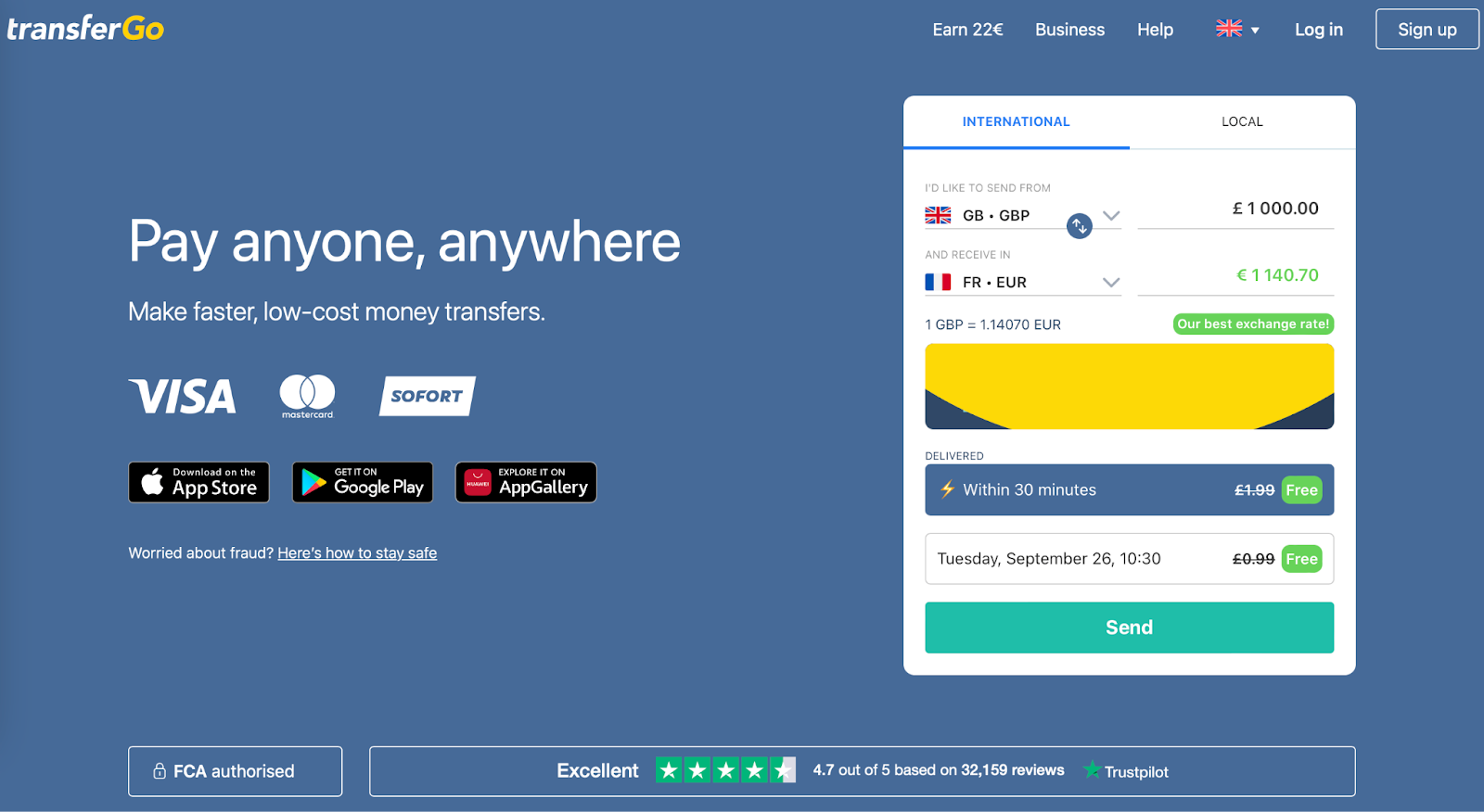
If you don’t want to calculate the TransferGo fees yourself, don’t worry, there is an easier way for you to see what your fees will look like before you even begin the transfer process. On the home page, you will see the TransferGo money transfer calculation tool. Enter where you are transferring money from, where you are transferring money to, and how much you are transferring. Then you will get a breakdown of what your transfer fees will be and how long your transfer will take. 


TransferGo frequently offers a promotional zero-fee option for first-time users, making it an attractive choice for those new to the service.

How Much Money Can I Send Using TransferGo Money Transfer? 

The answer to this question is short and sweet: with TransferGo, there are no limits to your transfers! 

If you plan to make a payment with a card, please be aware that there is a transaction limit of 10,000 GBP per transaction. However, there is no restriction on the number of transfer orders you can make.

How Long Does TransferGo Take to Transfer Money?

The time it takes for a TransferGo money transfer to be completed can vary depending on which delivery option you choose. The delivery options available to you will depend on your transfer details. 

Source: https://support.transfergo.com/hc/en-gb

The typical delivery options and their transfer times are as follows: 

  • Standard: Delivered in 1 working day
  • Today: Delivered by the end of the same day from when you created the transfer
  • Now: Delivered within 30 minutes of the transfer 

Is TransferGo Safe? 

TransferGo takes security and user protection seriously, and it employs several measures to ensure the safety of its customers' financial transactions. 

TransferGo adheres to AML and KYC regulations to detect and prevent money laundering and other financial crimes. Users may be required to provide identification documents as part of these checks.

TransferGo has identity verification processes in place to confirm the identity of users. This helps prevent fraud and ensures that the service is being used by legitimate individuals.

TransferGo uses encryption technology to protect sensitive user data, such as personal information and payment details. This encryption makes it difficult for unauthorized individuals to access this information.

How to Send Money with TransferGo?

Now for the biggest question you must have: how does TransferGo work?

TransferGo boasts a user-friendly interface that's easy to navigate and makes it easy to transfer money. 

Here's how to get started:

  1. Create an Account: Visit the TransferGo website or download the TransferGo mobile app from your app store.Sign up for an account by providing your personal information, including your name, email address, and phone number. You may also need to create a password.
  2. Verify Your Identity: To comply with regulatory requirements and increase your sending limits, you may need to verify your identity. This typically involves uploading identification documents, such as a passport or driver's license, and providing additional information.
  3. Initiate a Transfer: Once logged in, you can initiate a money transfer by clicking on the "Send Money" or "Send Transfer" option, typically found on the main dashboard.
  4. Provide Recipient Information: Enter the recipient's details, including their name, contact information, and bank account details. Make sure all the information is accurate to avoid any issues with the transfer.
  5. Choose the Transfer Amount and Currency: Specify the amount you want to send and select the currency in which you want to send the money. TransferGo will display the exchange rate and any applicable fees for your review.
  6. Select the Payment Method: Choose your preferred payment method. TransferGo typically offers options like bank transfer, credit/debit card, Apple Pay, Google Pay, and other local options, depending on your location.
  7. Review and Confirm: Once you are satisfied with the details, confirm the transfer. You may need to provide additional security information, such as a one-time verification code sent to your mobile device.
  8. Confirmation and Receipt: TransferGo will provide you with confirmation of the completed transfer, including a receipt or transaction reference number. Keep this information for your records.

And that's it! Your money transfer using TransferGo should be on its way to the recipient. Always ensure that you have accurate recipient information, and double-check the details before confirming the transfer to avoid any delays or issues.

How to Contact TransferGo? 

If you need to contact TransferGo for assistance, inquiries, or support, you can reach out to their customer service team through various channels. 

TransferGo typically has a comprehensive FAQ (Frequently Asked Questions) section and a help center on their website. You can search for answers to common queries or browse through articles for guidance. If you cannot find the question or answer that you are looking for, you can submit a query to the TransferGo team. 

You can send an email to TransferGo's customer support team at their official support email address: [email protected]

TransferGo also provides a customer support phone number that you can call for assistance: +441392694030


Pros of TransferGo Money Transfer

Based on our research of customer reviews and comparison to other remittance providers, the pros of the TransferGo money transfer service are:

  • No Transfer Limits: TransferGo does not impose a money transfer limit. There are certain restrictions if you are paying with a card, but TransferGo does have some workarounds. 
  • Transparent Fees: TransferGo is known for its transparent fee structure, which means you'll know exactly how much you're paying in fees before confirming a transfer. They may also offer promotions with zero fees for first-time users.
  • Fast Transfers: TransferGo offers both Express and Standard delivery options. Express transfers can be completed within minutes to a few hours, making it suitable for urgent financial needs.
  • Refer-a-Friend Program: TransferGo has a great referral program that allows you to earn rewards and benefits for referring TransferGo to your family and friends. 

Cons of TransferGo Money Transfer Service

Based on our research of customer reviews and comparison to other remittance providers, the cons of the TransferGo service are:

  • Not Available Worldwide: While TransferGo supports many countries, it may not cover all destinations, which could be a limitation for users with less common transfer needs.
  • Verification Process: Some users may find the identity verification process to be an extra step, although it is necessary for security and regulatory compliance.

TransferGo Money Transfer Service: Best Feature

One of TransferGo's standout features is their highly rewarding refer-a-friend program, known as the "Invite a Friend" program. With this program, you have the opportunity to earn money simply by inviting your friends to use TransferGo. 

Here's how it works: every time someone you've invited signs up and transfers 100 GBP or more (or the equivalent amount in any other currency), you earn a reward. The best part is that there's no limit to how many friends you can invite, which is why many TransferGo customers have earned substantial sums by recommending the service to family and friends. 

It's worth noting that same-currency transfers, like EUR to EUR, do not count toward the £100 threshold for the reward. 

To ensure you receive credit for your referrals, make sure your friends have their cookies enabled so TransferGo can track the unique link you provided. 

This program not only benefits you but also your friends, as they get to enjoy the convenience and cost-effectiveness of TransferGo for their own international money transfers while helping you earn some extra money in the process.

TransferGo Money Transfer Service Alternatives

If you’re looking for an alternative to TransferGo’s remittance service, here are some top remittance providers we recommend that offers low fees, excellent exchange rates, and are easy to use: 

TransferGo Reviews

Need more assurance about TransferGo? Is TransferGo legit? Let’s see what users of TransferGo have to say. Sourced from multiple platforms, customer reviews of TransferGo are: 

TransferGo scores an “Excellent” status on TrustPilot with a TrustScore of 4.7 out of 5. 

The customer support was helpful and they responded immediately you write them. They always make sure your funds are safe. Their exchange rate is also excellent compare to others.” - Sirmy on TrustPilot

The application is really successful and useful. The live chat feature is always very supportive. Also, my favorite feature is that when an urgent money transfer is required, money is sent in 30 minutes with a very small commission. They are really incredibly fast.” - User on G2

TransferGo is a smart way to send money to a loved one. It is available in over 63 countries. There transfer rates are lower than most others and takes not so long to transfer the money where you need it to be. The app and customer service is impressive at how helpful and secure they are.” - Sania A. on Supermoney

Negative reviews pertain to issues with the limited range of countries that you can send to and the currencies available to transfer as a result. 

To see even more trusted reviews from users of TransferGo, check out CompareRemit’s review page.  

Do We Recommend TransferGo Money Transfer?

TransferGo is a solid choice for international money transfers, offering competitive rates, low fees, and speedy transactions. Its user-friendly interface and commitment to security make it an attractive option for both first-time and experienced users. Whether you're sending money to family, friends, or for business purposes, TransferGo is worth considering as a reliable and cost-effective solution.

We invite you to compare remittance providers using CompareRemit’s comparison tool today to find the best rates, lowest fees, and fastest turnaround times for your specific destination and transfer amount.

 15907 views
Rate article:
(0.0)
 
 
Money Transfer FAQ's
Related Articles
what-is-fiat-currency
Fiat Currency: What It Is and How It Affects Your Money

Fiat currency, in simple terms, is the government-issued national currency. In the United States of America (U.S.A.), the dollar is the fiat currency. It is the legal tender, meaning it is used by American citizens for daily transactions and is required for paying debts and federal taxes. Unlike earlier times, modern fiat currency is not backed by any physical commodity, such as gold or silver. Instead, its value depends on supply and demand, as well as the stability and credibility of the government and its central bank that issues it.So yes, the dollar derives its value from public trust in the government and the Federal Reserve, as well as the stability of the American economy.However, the downside of fiat currency is that, since it is not tied to gold, silver, or any other commodity, its purchasing power erodes during periods of inflation. And, needless to say, fiat currency loses value when citizens lose faith in their government.Examples of Nations Losing Trust in Their Fiat CurrencyWhen public confidence in a currency collapses, the effects ripple through an entire economy. Here are real-world examples of countries facing that breakdown.1. Zimbabwe (Late 2000s)This Southeast African nation printed truckloads of money to cover government spending, which triggered hyperinflation. Prices doubled almost daily, and at one time inflation hit over 231 million percent. Citizens needed wheelbarrows of cash to buy just a loaf of bread. Eventually, the Zimbabweans abandoned the Zimbabwean dollar and switched to the U.S. dollar and other foreign currencies. They even turned to a barter system for their daily transactions.2. Venezuela (2016–2019)Years of economic mismanagement and dwindling oil revenue in this South American country led the government to print huge amounts of money, triggering inflation. Gradually, inflation spiraled into hyperinflation, wiping out savings as prices skyrocketed. Many Venezuelans turned to U.S. dollars, barter, or crypto just to survive.3. Argentina (Perpetually in Crisis, Most Recently 2018–2023)Argentina, again in South America, has long faced chronic inflation due to its debt crises and loss of confidence in government policies. Citizens often prefer U.S. dollars for savings, leading to a thriving black-market exchange rate. Persistent public distrust in their fiat currency continues to weaken the Argentine peso.Why Do Countries Even Use Fiat Currency?1. It Offers FlexibilityCentral banks adjust interest rates and manage the money supply through monetary policy. This flexibility is a major advantage of fiat currency and helps them respond to shifting economic conditions.For example, during the 2008 global financial crisis, the U.S. Federal Reserve slashed interest rates to near zero and injected liquidity into the banking system. This rapid response was only possible because fiat currency allows central banks to expand the money supply when needed.Similarly, during COVID-19, countries like the U.S., India, Japan, and the U.K. issued large stimulus packages and emergency relief funds by expanding their money supply, something possible only with a fiat currency and not possible under a gold-backed system.2. It Helps Manage InflationBecause the central banks can control the supply of money (fiat currency) and thus overall liquidity in the economy, they can fight inflation by tightening the money supply. For example, the European Central Bank raised interest rates aggressively in 2022 when Eurozone inflation hit record highs. This move helped stabilize prices.3. It Supports Modern Banking and Credit SystemsFiat currency forms the backbone of the modern banking system. It enables commercial lending, credit cards, mortgages and business loans, interbank transfers, and digital and electronic payments. For example, India’s massive digital payments ecosystem, especially UPI, works because the rupee exists as fiat currency that can be digitally created, stored, transferred, and settled in banking systems.Similarly, banks worldwide can issue loans by creating new deposits. This credit expansion would be extremely difficult under a commodity-backed currency.4. It Helps Stimulate or Slow the EconomyGovernments, through central banks, can lower the interest rates and thus increase the supply of money into the economy during times of recession. On the flip side, during economic booms when inflation is going through the roof, it can increase the interest rates to reduce credit and money supply in the economy and thus fight bouts of inflation.For example, Japan kept interest rates near zero for decades to stimulate growth and avoid deflation. This long-term strategy is viable because fiat currency allows flexible monetary control.How Does Fiat Money Work? 1. Government Issues the CurrencyThe government declares the national currency as legal tender. In the U.S., the Treasury prints physical money, while the Federal Reserve oversees the monetary system.2. No Commodity BackingModern fiat money is not backed by gold, silver, or any other physical commodity. A dollar cannot be exchanged for gold at a fixed rate.3. Its Value Comes From Trust and StabilityFiat money has no intrinsic value. Its worth depends on public confidence, government stability, economic performance, and inflation levels.4. Legal Tender Status Creates Built-In DemandDollars must be accepted for purchasing goods and services, paying debts, if any, and paying federal taxes. This requirement guarantees widespread use of the U.S. Dollar, the fiat currency of the U.S.A.5. Central Bank Controls the Money Supply Through Monetary PolicyThe Federal Reserve (U.S. central bank) guides liquidity in the financial system, meaning it can increase or decrease the amount of money in circulation. The Federal Reserve uses tools like adjusting interest rates, open-market operations, and controlling bank reserves. These tools help manage inflation, unemployment, economic growth, and recession recovery. How Can You Track Exchange Rates Smartly? If you send money abroad or deal with foreign currency, fluctuations in fiat exchange rates directly affect how much your family receives or how much your international transfers cost.This is where a platform like CompareRemit is incredibly useful. It lets you compare real-time exchange rates, transfer fees, and provider speeds in one place, helping you get the best value for your money instead of losing out to poor rates or hidden charges.Frequently Asked Questions About Fiat Currency (FAQs)Q: When did the U.S. stop using the gold standard?The United States fully abandoned the gold standard in 1971, when President Richard Nixon ended the convertibility of the dollar into gold. Since then, the U.S. dollar has functioned entirely as a fiat currency.Q: Does fiat money always lead to inflation?No. While fiat money can allow inflation if mismanaged, many countries maintain low and stable inflation for decades with responsible monetary policy. Inflation depends on economic conditions and central bank decisions, not simply the use of fiat money.Q: Is cryptocurrency considered fiat currency?No. Cryptocurrencies are not fiat currencies because they are not issued by governments and do not have legal-tender status. Their value comes from market demand, scarcity, and technology, not government backing.Q: Why do most countries no longer back money with gold?Gold-backed systems limit how much money an economy can create. Modern economies require flexibility for lending, digital payments, crisis response, and economic growth, making fiat systems more practical than commodity-backed ones.Q: Can a government run out of fiat money?A government that issues its own currency (like the U.S.) cannot “run out” in the literal sense. However, printing too much money can cause inflation or currency instability, so responsible monetary management is essential.Q: How does fiat currency affect interest rates?Because central banks control the money supply, they can adjust interest rates to influence borrowing, spending, and investment. Fiat currency gives central banks greater control over these economic levers.Q: Is fiat currency safer than commodity-backed money?Each system has pros and cons. Fiat currency offers flexibility, while commodity-backed money offers stability but less adaptability. Modern economies prioritize flexibility, which is why almost all countries use fiat currency today.Q: What protects the value of the U.S. dollar?The strength of the U.S. dollar comes from economic size, global confidence, its reserve currency status, the rule of law, and the credibility of the Federal Reserve—not from commodities.

dollar-vs-philippine-peso-today
What Does the Dollar vs Philippine Peso Today Mean for Your Money Transfer?

The fluctuating world of currency exchange can sometimes feel daunting, especially when you are planning on making remittances. You want to make sure every dollar you send translates into the most pesos possible for your recipient.This article will give you the inside scoop on what affects this important currency pair, and give you a full analysis of the dollar vs the Philippine peso today. It will also arm you with the knowledge to make the best choices for your remittances. Let's ensure your money transfers between the U.S. and the Philippines are always smooth and easy.Understanding the Dollar vs. Philippine Peso Exchange RateSince mid-July 2025, the US dollar (USD) has been steadily rising against the Philippine peso (PHP), recently reaching its highest level since November 2022. As of January 4, 2026  the 1 dollar vs Philippine peso exchange rate closed at ₱58.87, reflecting the current strength of the U.S. dollar against the peso.Factors affecting the dollar vs Philippine peso exchange rateThe dollar vs. the Philippine peso exchange rate is constantly fluctuating, influenced by several key factors. For anyone sending money to the Philippines, understanding the reasons behind the volatile market is crucial.Economic performance in both the US and the Philippines plays a significant role. A strong US economy can boost the dollar, while a healthy Philippine economy with controlled inflation can strengthen the peso.Interest rates, set by central banks like the US Federal Reserve and the Bangko Sentral ng Pilipinas (BSP), are crucial. Higher interest rates typically attract foreign investment, making a currency more appealing.Inflation also significantly impacts currency value. High inflation erodes purchasing power, potentially weakening a currency. The Philippines, being import-reliant, actively manages the peso's value to control imported inflation.Geopolitical events and global economic conditions can cause shifts. In uncertain times, the US Dollar often acts as a "safe haven," increasing its demand and potentially weakening the peso. Monitoring these factors can help you understand the dollar vs the Philippine peso rate today and optimize your conversions.What’s driving USD/PHP movements today?Bullish factors for the dollar:Rising U.S. Treasury bond yields make the dollar more attractive.High oil prices hurt the peso, as the Philippines is a major oil importer.Geopolitical tensions and investor risk aversion favor the USD.Continued equity outflows and current account deficits in the Philippines.Supportive factors for the peso:Ceasefire optimism in the Middle East improved regional sentiment, strengthening the peso by 0.7% a few months ago.Bangko Sentral ng Pilipinas (BSP) has hinted at market intervention to stabilize the peso.If the BSP maintains or raises interest rates while the Fed pauses, it may help attract capital inflows and support the peso.What Does the Dollar vs Philippine Peso Today Mean for Your Remittance?For those sending money from the U.S. to the Philippines, the current strong dollar works in your favor. You essentially get more pesos for every dollar sent. However, the volatility means timing your transfer matters.You can use a reliable comparison platform like CompareRemit to track real-time exchange rates, fees, and transfer speeds across top providers. This will help you lock in the best remittance value when the dollar is strong.How to Get the Best Rate for Dollar vs Philippine PesoTo truly get the most out of your money, it's essential to compare rates from various remittance providers. What one service offers for 1 dollar vs the Philippine peso today might be significantly different from another. Many providers update their rates frequently, sometimes even every minute. Here are some tips that can help:Real-time comparison tools: Utilize online comparison tools to get real-time data on exchange rates from multiple money transfer services. This allows you to instantly see which remittance provider offers the most pesos for your dollars.Check for promotional rates: Some remittance providers offer special promotional rates for new customers or specific corridors, such as USD to PHP. These can be temporary but offer excellent value, especially for your first few transfers.Understand the mid-market rate: This is the true exchange rate between two currencies, without any markups or fees applied by a money transfer service. Knowing it gives you a benchmark to assess how competitive a given offer truly is. The closer a provider's rate is to the mid-market rate, the better the deal you're likely to get.Consider the payment method: The way you fund your transfer and how your recipient receives the money can influence both the exchange rate and the fees. Bank transfers often have lower fees but might take longer, while card payments can be quicker but sometimes come with higher costs.Which is Best for Your Remittance Needs: USD or PHP?This is the core question for many sending money to the Philippines. The decision to send USD or PHP largely depends on your recipient's needs, current market conditions, and your chosen remittance service.When sending PHP might be best:If your recipient needs to use the money immediately for daily expenses, bills, or local purchases, receiving it directly in PHP is often the most convenient option. It eliminates the need for them to find a money changer and worry about local exchange rates, which can sometimes be less favorable than those offered by online remittance services.When you send PHP, you lock in the exchange rate at the time of the transaction. This provides predictability, as you know exactly how many pesos your recipient will receive. This can be particularly reassuring for families relying on a consistent amount of support.While some local money changers might offer seemingly good rates, they often have additional fees or less favorable rates for smaller transactions. Sending PHP directly through a reputable online service can help your recipient avoid these additional costs and hassles.When sending USD should be considered:If your recipient intends to save the money or make a significant purchase in the future, and they believe the Philippine peso might depreciate against the dollar, holding onto USD could be advantageous.In certain situations, your recipient might have expenses that are priced in USD, such as international school fees or certain imported goods. In such cases, receiving USD directly could be beneficial.Fees and Transfer Speeds: Key ConsiderationsWhen comparing dollar vs Philippine peso remittance options, don’t focus only on the exchange rate. Fees and transfer speeds can significantly impact the total value received.Even services that claim “zero fees” may offer a weaker dollar vs Philippine peso exchange rate, which can cost you more overall. Instead, look at the effective rate.Fixed fees: Charged per transfer regardless of the amount.Percentage-based fees: A cut of the total amount you send.Hidden fees in exchange rates: Markups that reduce your value without being obvious.Transfer speeds matter too. In urgent situations, how fast your funds arrive is crucial:Instant/minutes: For cash pickup or mobile wallet deposits.Same-day/next-day: Common for online bank deposits.1–3 business days: Typical for ACH-funded bank-to-bank transfers from the U.S.Factors Beyond Exchange Rates and FeesBeyond the dollar vs. Philippine peso exchange rate and fees, several other elements shape your remittance experience.First, security and reliability are paramount. Choose a licensed provider with strong encryption and fraud protection to safeguard your money and personal information. You need to trust the service you use.Second, consider convenience and user experience. A smooth, intuitive platform, whether online or via a mobile app, saves you time. Look for easy sign-up, transfer initiation, and tracking. Many services offer convenient options to send money online or through agent locations.Third, customer support is vital. Good support, accessible and responsive, can quickly resolve any issues, easing potential stress about your money transfer.Fourth, check payment and payout options. Does the service allow you to pay conveniently (e.g., bank transfer, card)? Crucially, are the payout options easy for your recipient in the Philippines? This includes direct bank deposits to major Philippine banks like BDO or BPI, cash pickup at various locations, or mobile wallet transfers to services like GCash or Maya.Lastly, be aware of any transfer limits too, especially for large amounts of 1 dollar vs Philippine peso conversions.Make Your Remittance Journey Easier with CompareRemitSending money abroad doesn’t have to be cumbersome or confusing. When looking at the dollar vs Philippine peso exchange rates, the key is to compare your options. With the right tools, you can save money and make sure your remittance, whether in USD or PHP, reaches your loved ones quickly.Use CompareRemit to find the best dollar vs Philippine peso exchange rate today, along with low fees and fast transfer times. It shows real-time rates from multiple providers, some of which you may not even know about. By comparing, you get more value and peace of mind. Start comparing now to get the most from every dollar.Frequently Asked Questions (FAQs)Q: When to exchange dollars for pesos?The best time to exchange depends on the current dollar vs Philippine peso exchange rate; aim for when you get more PHP for each USD. You can use services like CompareRemit to view your transfer options.Q: What is the current exchange rate for 1 dollar vs Philippine peso?As of 4 January 2026, 1 dollar vs Philippine peso stands at approximately ₱58.87. This rate varies based on market conditions, so it's best to check real-time rates.Q: What is the best time to buy the peso?The best time to buy the Philippine peso is when the U.S. dollar is strong and the peso is weak, meaning you get more pesos for each dollar.Q: What will happen to the Philippines if the dollar is higher?When the dollar vs Philippine peso rate rises, meaning the dollar strengthens against the peso, it can have mixed effects. For Filipino families receiving remittances, it’s a short-term benefit, as each dollar sent from abroad converts to more pesos. But a stronger dollar can also lead to higher import costs, rising inflation, and added pressure on the country’s current account deficit. This may impact the overall economy.Q: Where can I convert USD to PHP?You can convert USD to PHP through various online money transfer services, banks, and authorized money changers, with online platforms often offering competitive rates. To compare and get the best transfer rates, try tools like CompareRemit.

the-best-way-to-convert-pkr-to-usd-today
The Best Way to Convert PKR to USD: Check Today's Rate

When managing your finances across borders, especially for family support or international business, understanding currency exchange is crucial. If you are looking to convert PKR to USD, you've come to the right place. Millions of individuals and small business owners are regularly seeking the best rates and most efficient services to convert their money. In this article, we'll help you find the best Pakistani rupee to US dollar exchange rate. We'll also guide you in converting PKR to USD, ensuring you get the most value for your money.Pakistani Rupee to Dollar Rate TodayThe exchange rate between the Pakistan rupee to USD is a dynamic figure, constantly shifting due to a variety of global and local economic factors. 1 PKR to USD represents how much of a dollar you can get for 1 PKR. Similarly, the currency rate of the Pakistani rupee to the USD shows how many Pakistani rupees are equivalent to 1 USD.As of now, 1 PKR is approximately 0.0035 USD. This means 1 USD is roughly 284.3 PKR. The fluctuating nature of exchange rates makes it important to check the most up-to-date Pakistani rupee to dollar rate before initiating any transfer.What Influences the PKR to USD Exchange Rate?So, why do exchange rates fluctuate? Read on to know the factors behind the change in the currency rate of the Pakistan rupee to the US dollar. Understanding this can help you pick the right time to convert PKR to USD and get a better value.Inflation: When prices rise quickly in Pakistan, the value of the rupee tends to fall. As a result, you get fewer USD in exchange for your rupees. Keeping an eye on inflation trends can help you decide when to send money.Interest rates: Interest rates set by the State Bank of Pakistan and the US Federal Reserve influence the strength of each currency. Higher interest rates often attract foreign investors. This increases demand for the local currency, which can make it stronger.Economic and political stability: If Pakistan’s economy is growing and the political situation is stable, the rupee tends to do better. But if there's uncertainty, such as high unemployment or unstable leadership, the rupee may weaken. This directly affects the currency rate of the Pakistani rupee to the US dollar.Trade balance: When Pakistan imports more goods from the US than it exports, there's more demand for US dollars in the market. This can lower the value of the rupee compared to the dollar.National debt: A country with high debt can seem risky to investors. If Pakistan's debt levels increase, it may cause the rupee to depreciate, making it more expensive to convert PKR to USD.Global events: Events like wars and natural disasters or big changes in government policies can shake up currency markets. These events often lead to sudden changes in the Pakistani rupee to US dollar rate.PKR to USD: History and Forecast 2025 The Pakistani Rupee to US Dollar conversion has seen a pattern of gradual depreciation over the years, although 2025 has shown signs of relative stability. Looking back, the Pakistani rupee to dollar rate today is slightly stronger than its 2025 high of ₨ 293.33 recorded in March, but weaker than its January low of ₨ 278.48. Overall, the 2025 average exchange rate is about ₨ 280.96, according to year-to-date data. These figures reflect only minor fluctuations in the currency rate of PKR to USD, suggesting a more controlled foreign exchange environment last year.MonthRange (₨ per $1)Consensus Avg.August281.3 – 292.8287.0September281.6 – 293.1287.3October280.4 – 291.9286.2Nov–Dec280.8 – 292.3286.5The Pakistani rupee to dollar exchange rate today is relatively steady, thanks to improved economic management, monetary controls, and some external financial support. However, the conversion of PKR to USD value may still be influenced by inflation, global oil prices, and domestic political developments.Overall, if you're planning to convert Pakistani rupees to US dollars in 2026, you're likely to experience relatively stable rates, especially in the ₨ 285–₨ 290 per USD range. How to Convert Pakistani Rs to US Dollars: Your OptionsWhen you need to convert Pakistani rupees to US dollars, you have several avenues available, each with its own advantages and disadvantages concerning exchange rates, fees, and transfer speed.Online money transfer servicesOnline money transfer services have become increasingly popular for their convenience, competitive rates, and lower fees compared to traditional banks. These platforms specialize in international remittances, often offering better Pakistan rupee to US dollar conversion rates.They generally offer better exchange rates and lower fees. Transfers are often faster, with many services providing same-day or next-day delivery. They are accessible 24/7 through websites or mobile apps. While typically cost-effective, fees can vary between providers and for different transfer amounts. It’s always wise to compare.BanksTraditional banks offer international money transfer services, which can be a familiar option for many. Banks are often seen as a secure and reliable option, especially for large transfers. If you or your recipient already has an account with the same bank, transfers might be quicker.Banks in Pakistan or banks in general often have higher transfer fees and may offer less competitive exchange rates, including a hidden markup on the interbank rate. This can mean your recipient receives fewer USD for the same amount of PKR. Transfer times can also be longer.Currency exchange bureausFor smaller, in-person conversions, currency exchange bureaus are an option. These are convenient for immediate cash conversions when traveling.Exchange rates at these bureaus can be less favorable than those offered by online services or banks, and they may charge additional commissions or fees. They are not ideal for sending money internationally to a recipient's bank account.Getting the Best Pakistani Rupee to US Dollar Exchange RateFinding the best Pakistani rupee to US dollar exchange rate can significantly impact the amount of US dollars your recipient receives. Here's how you can maximize your transfer:Compare exchange rates: Exchange rates fluctuate, and different providers offer different rates. The Pakistani rupee to dollar rate today from one provider may differ from that of another provider tomorrow. Use comparison platforms to see real-time rates from various providers side by side.Look beyond zero fees: Some money transfer services say they charge zero fees or no commission. It’s important to check the currency rate they are offering in such cases. Many a time, the service makes a profit by giving you a lower exchange rate. So even if you don’t see a fee, your recipient might still end up with less money.Understand the mid-market rate: It’s the halfway point between the buying and selling rates that banks use to trade with each other. Most money transfer services don’t use this exact rate; they add a markup. By knowing this rate, you can compare and see how much extra a provider is charging.Consider transfer fees: Beyond the exchange rate, transfer fees can eat into your money. Some providers have flat fees, while others charge a percentage of the transfer amount. For larger transfers, a percentage-based fee might be more expensive.Time your transfer: If you are not in a hurry, monitoring the Pakistani rupee to US dollar rate can help you send money when the rate is most favorable. Even small improvements in the exchange rate can make a difference for significant transfer amounts.Check for promotions: Many money transfer services offer promotional rates or reduced fees for first-time users or specific corridors. Keep an eye out for these deals.Your Next Step for Smart Money TransfersUnderstanding how to convert PKR to USD is just the first step. The real magic happens when you can effortlessly compare your options and secure the best deal. With fluctuating exchange rates and varying fees, comparing providers is essential to ensure more of your money reaches its destination.This is where CompareRemit comes in. Our platform empowers you to compare various remittance providers side by side, giving you real-time data on exchange rates, fees, and transfer speeds. Instead of manually checking multiple websites, you can find the most cost-effective and efficient way to send money.Start comparing now and experience how simple and rewarding international money transfers can be.Frequently Asked Questions (FAQs)Q: Why does the Pakistani Rs to US dollar conversion rate change?The conversion rate from Pakistani rupee to US dollar fluctuates due to factors such as inflation, global oil prices, political stability, trade balances, and interest rate differences between the US and Pakistan.Q: What has been the highest exchange rate for the Pakistani rupee ever?The highest exchange rate for the Pakistani Rupee (PKR) against the US dollar, which actually means the lowest value of the PKR, was in September 2023, when 1 USD equaled 307.75 PKR. Q: How can I get the most value when transferring PKR to USD?To get the best Pakistani rupee to US dollar rate today, monitor trends regularly and use rate comparison tools. Sending money when the PKR is strong or the USD is weak can also help maximize value.Q: Will the Pakistani rupee get stronger?The Pakistani rupee has shown periods of strengthening, notably in late 2025, due to factors like an extended IMF loan program, government crackdowns on currency smuggling, rising remittances, and improved foreign exchange reserves. However, its future strength depends on various factors.Q: What is the limit to convert PKR to USD?Limits to convert Pakistani Rs to US dollars depend on the specific money transfer service or bank you use and the relevant regulations in both countries.

Download the CompareRemit App
Personalize your CompareRemit experience with your preferred corridor and receive target exchange rate notifications, seamless transitions to partner apps, and real-time comparisons of top remittance providers at your fingertips.

Get Listed or Advertise

Download Our Free App

Try our faster, enhanced mobile app for a better experience

CompareRemit App