USD INR ₹ 95.67
GBP INR ₹ 127.76
CAD INR ₹ 66.14
Guides

Vance Money Transfer: Review & Comprehensive Guide

Updated on October 31, 2023 04:15 am
Vance Review & Guide

In the ever-evolving landscape of financial technology, neobanks have emerged as a revolutionary force, providing innovative and efficient solutions for managing finances. Vance Money Transfer is a pioneering neobank service that offers a seamless and secure way to transfer money. 

In this comprehensive review and guide, we will explore the key aspects of Vance, including its unique features, cost, speed, safety, step-by-step instructions for money transfer, pros and cons, and more.

What is Vance Money Transfer?

Vance Money Transfer, offered by the neobank Vance, is a cutting-edge solution designed to meet the needs of individuals seeking efficient international money transfers, especially those with NRE (Non-Resident External) and NRO (Non-Resident Ordinary) accounts in India. Vance is a neobank that specializes in NRI (Non-Resident Indian) banking services, offering a range of financial solutions tailored to the unique needs of the Indian community.

What sets Vance apart from traditional banks is its user-friendly digital platform, which provides an exceptional level of convenience and transparency. Vance offers a unique combination of advanced technology and personalized service, making it a go-to choice for those in need of hassle-free money transfer services.

Keep in mind that currently, Vance only supports GBP to INR and AED to INR transfers. However, they are working hard to add more currencies to their list.

How Much Does Vance Cost? 

Does Vance have a limit on how much money I can send? 

Vance applies a fixed fee of 3 GBP for every transfer made from the UK to India. Regardless of the sum being transferred, this fee remains consistent. Furthermore, there are no additional costs as Vance does not impose any extra mark-up on the live conversion rate, ensuring a fair and honest transaction experience every single time!

Furthermore, at the time of writing this article, Vance is offering a first time special for new customers. On your first transfer, you can get your first money transfer for free. 

How Long Does Vance Take to Send Money? 

One of Vance's standout features is its rapid transfer speed. Utilizing advanced technology, Vance Money Transfer enables near-instantaneous fund transfers, ensuring that your money reaches its destination swiftly, a crucial aspect for urgent financial needs and emergencies.

Is Vance Safe? 

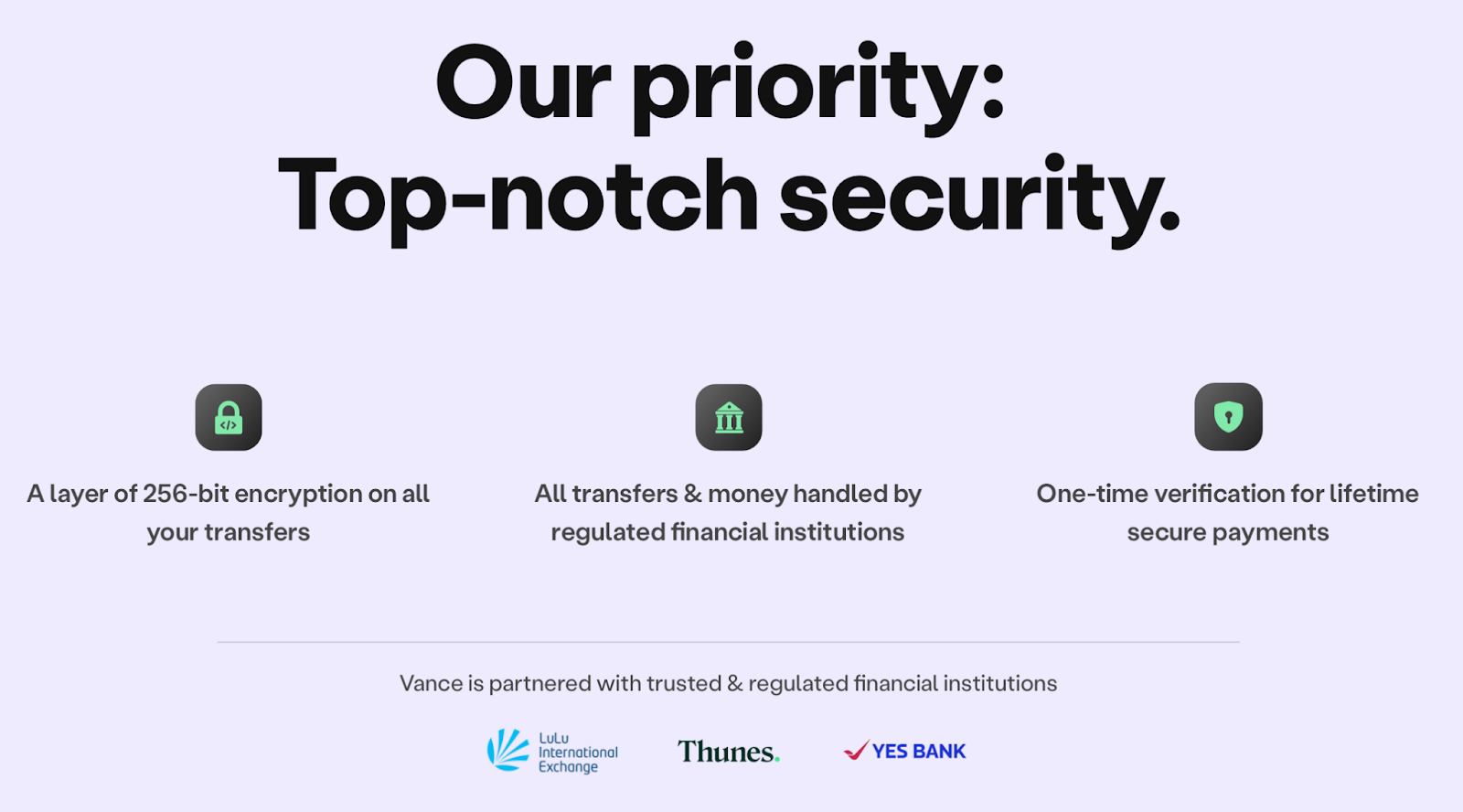
You might be wondering, is Vance reliable? Don’t worry!  Safety is a top priority for Vance Money Transfer. Vance utilizes state-of-the-art encryption and security measures to protect user data and transactions. As a part of the Vance neobank, your money is safeguarded in compliance with the regulatory standards governing neobanks. Additionally, Vance provides customer support and resources to help users make safe and secure transfers.
How to Send Money With Vance? 

Now for the biggest question you must have: how does Vance work?

Luckily, using Vance for your international money transfers is relatively straightforward. Here's a step-by-step guide:

  1. Sign Up: Start by creating an account on Vance Neobank's platform.
  2. Verification: Complete the necessary verification steps, ensuring compliance with regulatory requirements.
  3. Link Your Account: Connect your NRE or NRO account to Vance for seamless transfers.
  4. Enter Transfer Details: Input the recipient's information and the amount you wish to transfer.
  5. Review and Confirm: Double-check the details and confirm the transfer.
  6. Track Your Transfer: Use Vance's tracking feature to monitor the status of your transaction in real-time.
  7. Funds Delivered: Once processed, the funds are swiftly delivered to the recipient's account.

How to Contact Vance? 

Getting in touch with Vance for assistance is a hassle-free experience thanks to their multiple contact options. For starters, their extensive FAQs section covers a wide array of queries, providing instant solutions for common concerns. 

If customers need more personalized help around the clock, they can reach out via email at [email protected] or chat with the support team on the Vance app. 

Pros of Vance Money Transfer

Based on our research of customer reviews and comparison to other remittance providers, the pros of the Vance money transfer service are:

  • Transparent Pricing: Vance maintains transparent fee structures and provides competitive exchange rates, ensuring users are aware of the costs associated with their transactions.
  • Instant Transfer Processing: Vance Money Transfer processes transactions swiftly, if not instantly. This enables recipients to access funds in a timely manner, often within a shorter time frame compared to traditional banking systems.
  • User-Friendly Interface: The platform features a user-friendly interface, making it easy for users to navigate through the process of initiating and tracking their transfers.
  • Secure and Encrypted Transactions: Vance Money Transfer employs advanced security measures, including encryption protocols, to ensure the safety of user data and financial transactions, providing peace of mind to users.
  • Dedicated Customer Support: Vance offers dedicated customer support, providing assistance and guidance to users throughout the transfer process, enhancing the overall user experience.

Cons of Vance Money Transfer Service

Based on our research of customer reviews and comparison to other remittance providers, the cons of the Vance service are:

  • Limited Availability: Vance only allows GBP to INR and AED to INR transfers. If you are looking to transfer any other currency, you may need to find an alternative money transfer service. 
  • Limited Physical Presence: Vance has limited physical branches, which might be a drawback for users who prefer in-person support or assistance or would like cash-pickups .

Vance Money Transfer Service Alternatives

If you’re looking for an alternative to Vance’s remittance service, here are some top remittance providers we recommend that offers low fees, excellent exchange rates, and are easy to use: 

Vance Reviews

Need more assurance about Vance? Is Vance legit? Let’s see what users of Vance have to say. Sourced from multiple platforms, customer reviews of Vance are: 

Vance scores an “Excellent” rating on TrustPilot with a TrustScore of 4.6 out of 5. 

“The entire money transfer process was remarkably smooth and hassle-free. From the moment I initiated the transaction to the instant the funds reached the recipient in India, Vance Money Transfer ensured a secure and reliable experience. ” - Sampath on App Store

“It has completely transformed the way I send and receive money, and I couldn't be happier with the service it provides. I no longer have to worry about losing a significant chunk of my money in transfer fees. Vance's pricing is transparent, and I appreciate that they keep it affordable for their users.” - Gurchetan on TrustPilot

“I recently used Vance to transfer money from the UK to India, and I'm beyond impressed with their service. Not only did they offer the best exchange rate, but the transfer was completed in under 2 minutes! ” - User on App Store

Do We Recommend Vance?

Vance Money Transfer, offered by Vance Neobank, stands out as a reliable and efficient solution for individuals engaged in NRI banking, holding NRE or NRO accounts. With its cost-effective approach, swift transaction processing, and emphasis on security, Vance ensures a hassle-free experience for users looking to transfer money internationally. By combining technology and financial expertise, Vance Money Transfer sets a high standard in the realm of neobanking, making it a preferred choice for those seeking trustworthy and convenient international money transfer services. 

We invite you to compare remittance providers using CompareRemit’s comparison tool today to find the best rates, lowest fees, and fastest turnaround times for your specific destination and transfer amount.

 18246 views
Rate article:
(4.0)
 
 
Money Transfer FAQ's
Related Articles
is-the-pound-stronger-than-the-euro
Euro vs Pound: Which Currency Has More Value?

As a U.S. citizen living abroad or maintaining financial ties overseas, you've probably noticed how currency values shift when you send money to the UK or Europe. The pound vs euro comparison matters because these fluctuations directly affect how much your recipient actually gets. A favorable exchange rate can mean hundreds more dollars in value delivered, while an unfavorable rate quietly reduces the value delivered to the recipient. Currency strength isn't just about which unit trades higher against the dollar. Interest rates, economic performance, and central bank policies all play a role in determining real value. This article breaks down what drives the pound vs. euro relationship, how exchange rates impact your transfers, and the practical steps you can take to maximize value when sending money from the US to the UK or Eurozone.Understanding the Pound vs. Euro Exchange RateThe first thing you need is a clear picture of how these two currencies behave against each other. Once you understand the basics, the rest of the comparisons start to make sense.According to Federal Reserve data, from late 2024 and early 2025, one British pound (GBP) equals approximately $1.31, while one euro (EUR) equals around $1.08. This means the currency pound vs. euro shows £1 ≈ €1.14.That numerical difference doesn't automatically make one currency economically "stronger." Real currency strength involves purchasing power, trade balances, and monetary policy effectiveness. The euro vs. pound rate has remained relatively stable in recent years, partly because the UK and Eurozone remain closely linked through trade, financial markets, and overlapping economic cycles.For practical purposes, U.S. expats need to focus on two factors: the USD exchange rate for whichever currency you're sending, and the total cost of your transfer. You can track current official rates through the Federal Reserve's H.10 release, which publishes weekly bilateral rates. For guidance on how exchange rates work, see this comprehensive guide to exchange rates.Now that you have the foundation, it helps to look at what actually pushes these currencies up or down. Exchange rates don’t move randomly — they respond to a few big economic forces.What Determines Currency Strength Between the Pound and the EuroSeveral economic drivers influence whether the British Pound or the Euro strengthens or weakens at any given time:Interest rate differentials: When the Bank of England maintains higher policy rates than the European Central Bank, capital tends to flow toward sterling, strengthening GBP. Similarly, Federal Reserve rate decisions affect the dollar and therefore impact both USD/GBP and USD/EUR crosses. Recent reporting shows that rate expectations drive much of the short-term volatility in these pairs.Economic growth and data: Stronger-than-expected UK or Eurozone economic performance supports the respective currency. Purchasing Managers' Index (PMI) readings, GDP reports, and employment data all move exchange rates. The UK pound vs. euro rate responds particularly to UK-specific fiscal developments and trade figures.Trade flows and external balances: The euro reflects trade dynamics across 19 countries, making it sensitive to broader European economic trends. Sterling responds more directly to UK trade performance and budget policies. Market analysis, including commentary from major investment banks such as Goldman Sachs, has linked recent euro strength to expectations of increased European fiscal spending and diversification away from U.S. assets.Market sentiment: Speculative positioning and risk appetite can amplify moves in either currency over days or weeks, particularly around major policy announcements or economic surprises.In practice, currency debates only matter if they change what your recipient gets. Once you bring transfers into the picture, the conversation becomes far more practical.How the Pound vs. Euro Rate Affects Your TransfersFor U.S. expats sending money abroad, the pound vs. euro debate matters less than understanding your specific transfer route. If you're sending to a UK bank account, you must deliver GBP. If you're sending to France, Germany, or another Eurozone country, you need EUR. The currency choice is usually determined by your recipient's account, not by which currency is theoretically stronger.What most directly affects your transfer value is the exchange rate your provider offers and the total fees charged. World Bank remittance data shows that exchange-rate margins typically represent the largest component of transfer costs, often exceeding explicit fees. A provider advertising "zero fees" may still take 2-3% through a marked-up exchange rate.The delivered rate differs from the mid-market rate you see on financial news sites or the Federal Reserve's official rate. Providers add a margin to cover their costs and profit. That margin varies widely by company, corridor, and transfer size. Comparing actual delivered amounts across providers reveals the true cost.U.S. senders should also consider timing. Major events like Federal Reserve meetings, Bank of England policy announcements, or European Central Bank decisions can move rates quickly. If you have flexibility, monitor rates over several days or use rate-lock features when available. For ongoing updates on currency movements, check CompareRemit's news section regularly.Once you understand how currencies behave, the next step is deciding how to send money in a way that protects your value. A few smart habits can make a noticeable difference.Practical Steps for U.S. Expats Sending Pounds or EurosHere’s what to keep in mind before you transfer pounds or euros from the US.Compare delivered rates, not advertised fees: Request the exact exchange rate each provider will apply and calculate the recipient amount. Small advertised fees can hide substantial rate markups. Use tools to compare multiple providers side-by-side, examining both explicit fees and the exchange rate offered.Verify provider compliance: U.S. money transmitters must register with FinCEN as Money Services Businessesand obtain state licenses, which are tracked through the National Mortgage Licensing System (NMLS). Check that your chosen provider maintains proper registration and licenses. This protects you under the CFPB's Remittance Transfer Rule, which requires advance disclosure of fees, exchange rates, and delivery amounts.Consider transfer methods: Different channels offer distinct tradeoffs. Bank-to-bank transfers may cost less but take longer. Online platforms often provide competitive rates with faster delivery. Mobile apps offer convenience but vary in pricing. Compare banks vs. service providers before deciding.Keep documentation: Under federal regulations, covered providers must give you written disclosures showing the amount sent, exchange rate used, total fees, and estimated delivery time. Save these receipts for tax purposes and potential dispute resolution. Large international transfers may trigger IRS reporting requirements, particularly for gifts or substantial sums.Review multiple providers: Comparing money transfer services helps you find the best value for your specific corridor and amount. Rates and fees vary by destination country, transfer size, and payout method. What works best for a $500 transfer to the UK might differ from a $5,000 transfer to Germany.When evaluating options, review money transfer company ratings to understand customer experiences. Look for providers with strong customer service, transparent pricing, and reliable delivery. If you're sending money from the UK back to the U.S., similar principles apply but in reverse.Many expats benefit from setting rate alerts to catch favorable exchange rates for planned transfers. Some providers also offer promotional rates or coupons; check current money transfer promotions before sending.Security and Consumer ProtectionU.S. regulations provide substantial protection for international money senders. The CFPB's remittance rule establishes error-resolution rights and cancellation windows. State supervision through licensing requirements creates additional oversight layers.Choose providers that clearly display their licensing information and regulatory compliance. Avoid unregulated channels that may offer attractive rates but lack consumer protections. For comprehensive guidance on secure transfers, read how to send money online safely and fast, and review keeping your money safe.When selecting a money transfer app, verify that it maintains proper US registration and offers transparent pricing. Legitimate providers will readily share their fee structure and exchange-rate methodology.Your Next Transfer DecisionThe pound vs. euro comparison ultimately comes down to your specific transfer needs rather than abstract currency strength. Focus on the delivered amount your recipient gets, the total cost you pay, and the provider's reliability and security.Exchange rates fluctuate daily based on complex economic factors. What matters most is getting a fair rate when you need to send money. Check live rates across multiple providers to ensure you're receiving competitive pricing. The Federal Reserve's mid-market rate provides a useful benchmark for evaluating provider markups.For any transfer, request detailed disclosure of all fees and the exact exchange rate before confirming. Compare several options to find the best value for your corridor and amount.Use CompareRemit's comparison tool to evaluate providers side-by-side with real-time data on rates, fees, and delivery times. The right choice depends on your priorities—whether that's speed, cost, convenience, or customer service.Frequently Asked Questions (FAQs)Q: Is the pound currently stronger than the euro?Yes, in nominal terms. As of early 2025, £1 equals approximately €1.14. However, the currency pound vs. euro strength involves more than the unit price. For instance, purchasing power, interest rates, and economic fundamentals all matter for true comparison.Q: How does the pound vs. euro rate affect my transfer costs?The pound vs. euro rate determines conversion costs if you're moving between those currencies. For U.S. senders, what matters more is the USD exchange rate your provider offers for whichever currency you need.Q: Which currency offers better value for U.S. expats sending money abroad?Neither the British pound vs. euro is inherently better. Choose based on your recipient's location and account currency. Focus on comparing total transfer costs (fees plus exchange-rate markup) across providers rather than currency unit values.Q: Can I lock in a favorable pound vs euro exchange rate?Some providers offer rate-lock or forward contract features for future transfers. Check whether your provider offers this option and understand any associated terms, fees, or minimum amounts before committing.Q: How often do pound vs. euro rates change?The euro vs. pound rate fluctuates continuously during trading hours. Major moves often follow central bank announcements, economic data releases, or political events. Monitor rates through official sources like the Federal Reserve or financial news outlets.Q: What protections do U.S. senders have for international transfers?The CFPB's Remittance Transfer Rule requires advance disclosure of fees and rates, plus error-resolution rights. Providers must maintain FinCEN registration and state licenses. Always use regulated, licensed services for maximum protection.

Portfolio Investment Scheme
Portfolio Investment Scheme: An NRI Guide for 2026

As a non-resident Indian (NRI) or overseas citizen of India (OCI), investing in India’s dynamic stock market can help you grow your wealth while staying connected to your roots.In 2024, the BSE Sensex delivered an impressive 8.2% return, marking its ninth consecutive year of gains. The Portfolio Investment Scheme (PIS) offers a regulated and streamlined route for NRIs to invest in Indian equities and securities.This guide explains the meaning, mechanics, eligibility criteria, and application process of the Portfolio Investment Scheme. See how the PIS is connected to remittances and how CompareRemit’s exchange rate calculator can help you maximize every dollar you send to fund your investments.What is the Portfolio Investment Scheme? The Portfolio Investment Scheme, overseen by the Reserve Bank of India (RBI), enables NRIs and OCIs to invest in the Indian stock markets through a structured framework. Launched in 1992, PIS enables you to buy and sell equity shares, convertible debentures, and other securities listed on recognized exchanges, such as the BSE and NSE. The scheme was introduced to attract foreign investment while ensuring transparency and regulatory control.By routing investments through designated bank accounts, the RBI monitors transactions and facilitates compliance. For NRIs, PIS provides a secure way to tap into India’s growing economy.Now that you understand the basics, let’s explore how PIS functions in practice.How Does the Portfolio Investment Scheme Work?The PIS operates through a clear, regulated process:Designated bank accounts: Investments must flow through NRE (Non-Resident External) or NRO (Non-Resident Ordinary) accounts with an RBI-authorised bank.Transaction tracking: All PIS transactions are reported to the RBI for compliance with FEMA regulations.Repatriation: NRE-linked accounts permit full repatriation of funds, whereas NRO accounts are subject to restrictions.Here's an example of how it would work:To buy shares of Tata Motors, you transfer USD to your NRE account using a money transfer service and convert it to INR. You then instruct your bank to execute the purchase via your linked demat and trading accounts.To fund your PIS account efficiently, use CompareRemit’s comparison tool and find the best USD to INR exchange rates. How Does the Portfolio Investment Scheme Work?PIS outlines who can invest, the types of assets permitted, and the regulatory framework governing these transactions. Here's a breakdown of how it functions, from eligible participants to RBI compliance rules:Eligible investors: Only NRIs and OCIs can participate; resident Indians and non-OCI foreign nationals are excluded.Permissible investments: Equity shares, convertible debentures, and securities listed on BSE or NSE.Prohibited sectors: Investments in real estate, chit funds, or Nidhi companies are restricted, with sectoral caps (e.g., 10% for banking).RBI guidelines and compliance: The Reserve Bank of India regularly updates its operational guidelines for PIS. These cover investment limits, reporting requirements, and account operations. All investments must be routed through designated banks and brokers registered with the stock exchanges.How to Apply for the Portfolio Investment SchemeGetting started with the PIS is a fairly simple process, but it does involve a few key steps and documents. Here's how to apply and get your account set up:Choose a designated bank: Select an RBI-authorized bank, such as HDFC, ICICI, or SBI, that offers PIS services.Open NRE/NRO account: Link an NRE or NRO account to your PIS application.Submit PIS application: Complete the bank’s PIS form, available online or at branches.Provide KYC documents: Submit your passport, visa, PAN card, and overseas address proof.Link your demat and trading accounts: Connect your PIS account to a demat and trading account with a registered broker.Approval timeline: Expect approval within 7-10 business days.Once approved, you’ll need to decide between picking an NRE and or an NRO account for your investments.NRE vs. NRO Accounts Under PISChoosing the right account type is critical for PIS. Here’s a comparison between NRE and NRO accounts so that you can pick the right one for your needs:FeatureNRE accountNRO accountRepatriabilityFully repatriable (principal and profits)Restricted; requires RBI approvalTaxationInterest is tax-freeInterest taxable (up to 30%)Investment ScopeEquity, debentures, and mutual fundsSame as NRE accounts, with repatriation limitsBest ForLong-term investors seeking repatriationInvestors with Indian incomeMany NRIs prefer using NRE accounts for their repatriation benefits, especially for equity investments. Explore CompareRemit’s NRI services to compare top Indian banks offering NRE and NRO accounts, view account types, contact details, required documents, and apply seamlessly in one place.Now, with the account choice clear, let’s look at why PIS is appealing to NRIs.Benefits of the Portfolio Investment Scheme for NRIsPIS offers several advantages for global Indians:Seamless market access: Invest directly in India’s stock market without intermediaries.RBI oversight: Ensure transparency and FEMA compliance.Tax clarity: Enjoy tax-free interest with NRE-linked accountsRepatriation flexibility: Get easy fund repatriation with NRE accountsWhile PIS has clear advantages, it’s also important to understand its limitations.Limitations and Important GuidelinesPIS comes with specific rules for NRIs that you must keep in mind:Investment limitsNRIs and OCIs can hold up to five percent of a company’s paid-up equity capital. The total cap across all NRI and OCI investors in a single company is 10 percent, extendable up to 24 percent or the sectoral FDI limit, with board and regulatory approval.No intraday tradingPIS does not allow intraday trades. All equity trades must be settled on a delivery basis. You must hold shares for at least one day before selling. Short selling and derivatives trading are not permitted.Brokerage and bank chargesBanks typically charge a one-time PIS account setup fee (around ₹1,000) and annual maintenance fees (from ₹500 to ₹1,000). Each buy or sell transaction reported to the RBI attracts a processing fee (usually ₹100 to ₹200), in addition to standard brokerage (often capped at 0.5 percent or a flat rate). Demat and trading account charges may apply based on your broker’s policy.RBI monitoringAll PIS transactions are reported to the RBI by the designated banks. The RBI monitors compliance with sectoral limits and FEMA rules. If limits are breached, corrective actions may follow. Following these rules helps you invest transparently and stay compliant with Indian regulations under the PIS.PIS and Remittances: What You Should KnowFunding your PIS account efficiently can boost your investment returns. Exchange rate fluctuations, such as those influenced by global trade policies, demonstrate how the USD to INR currency trends affect remittances. For NRIs, timing INR transfers is crucial:Optimize currency conversion: Use CompareRemit’s rate comparison tool to find the best USD to INR rates. The INR is trading at ₹86.35 against USD as of July 22, 2025.Avoid double conversion fees: Transfer directly to your NRE account to minimize costs.Track exchange rates: Set alerts on CompareRemit to catch favorable rates, as INR has fluctuated between ₹84.22 and ₹87.79 against USD in 2025.Many more remittance providers offer competitive rates and fast transfers. Check reviews of remittance companies on CompareRemit to find the best fit for your PIS funding needs. With a clear remittance strategy, let’s wrap up with how to make the most of PIS.Maximize Investment, Minimize HassleThe Portfolio Investment Scheme for NRIs empowers you to invest in India’s thriving stock market with confidence and transparency. By understanding what the Portfolio Investment Scheme is, how it works, and its eligibility criteria, you can make informed decisions to grow your wealth.Pairing PIS with smart remittance planning ensures your money goes further. For instance, sending $1,000 at 83 INR/USD yields 83,000 INR, but at 84 INR/USD, you get 84,000 INR. It's a 1,000 INR difference that adds up.To maximize your investments, use CompareRemit’s tools to compare exchange rates, fees, and transfer times.Select low-fee services, such as mobile wallets or bank transfers, to efficiently fund your PIS account. With the right approach, your hard-earned money can achieve maximum impact in India’s stock market.Frequently Asked Questions (FAQs)Q: What is the meaning of the Portfolio Investment Scheme for NRIs?PIS enables NRIs and OCIs to invest in Indian stock markets through RBI-regulated NRE/NRO accounts, ensuring transparency and compliance.Q: How do I apply for the Portfolio Investment Scheme in 2025?Open an NRE/NRO account with an RBI-authorized bank, submit the PIS application with KYC documents, and link your demat/trading account. Approval usually takes 7–10 days.Q: Can I invest through both NRE and NRO accounts under PIS?Yes, NRE accounts offer full repatriation of funds, while NRO accounts have restrictions on repatriation; choose based on your specific needs.Q: Are intraday trades allowed under the PIS?No, intraday trading is prohibited; shares must be held for at least one day under PIS rules.Q: How does PIS differ from other NRI investment routes?PIS is for stock market investments under RBI oversight, unlike FDI or mutual funds, which follow different regulations.Q: How can I get the best exchange rate when remitting funds for PIS?To maximize your investment value, it’s essential to compare exchange rates and transfer fees before sending money. CompareRemit lets you compare real-time exchange rates and fees across leading money transfer services so you get the most out of every dollar you send to fund your PIS investments.

PayPal Fees review
Understanding PayPal Fees & Services for Transfers

If you’ve ever sent money abroad or received international payments, chances are you’ve used PayPal. Known for its ease of use, strong security, and global reach, PayPal has become a trusted choice for millions worldwide. Be it supporting your family, receiving freelance payments, or sending money to a small business, PayPal has you covered in most cases.While it’s convenient, it’s worth understanding how PayPal’s payment services and fees work so you don’t run into surprises. From personal transfers to business invoicing, PayPal offers a flexible range of electronic payment services for all kinds of users.In this article, we break down PayPal’s core services, explain its common fees, and show how options like CompareRemit can help you discover better-value alternatives for international money transfers. With the right information, you can use PayPal confidently and make better, smarter financial decisions.PayPal’s Core Payment ServicesPayPal provides a wide range of digital payment services, making it easy to send, receive, and manage money. Its electronic payment services make it easy to handle transactions globally, when it comes to paying for products, services, or sending remittances.Personal transactionsIf you're using PayPal for everyday personal needs, here’s all you can do for personal transactions:Send money to family or friends using your PayPal balance, linked bank account, or a card.Pay for purchases at online merchants.Use peer-to-peer services like Venmo (PayPal-owned) for casual transfers within the U.S.Business payment servicesPayPal also supports small businesses with a suite of services:Invoices and recurring billing: Great for freelancers and service providersPoint-of-sale (POS) tools: With PayPal Zettle, you can accept in-store paymentsPayPal.Me for Business: Share a personalized link to get paid instantlyWorking capital and business loans: Available to eligible sellers based on account historyThese business payment services make it convenient to accept payments, but they often come at a cost, especially when foreign currency is involved.Consider a freelance designer in the U.S. who uses PayPal to send invoices globally with just a few clicks, or a boutique owner using PayPal Zettle to accept payments at pop-up markets. These tools are designed with real-world business needs in mind, making it easy to manage sales, track payments, and access working capital. These online payment services for small businesses simplify international sales and reduce administrative hassles.The integration of invoicing, subscriptions, and merchant financing into an ecosystem simplifies cash flow management. Many entrepreneurs find this all-in-one approach highly efficient, especially when building a business that spans countries.What Fees Does PayPal Charge?Many users rely on PayPal’s credit card payment services when it comes to domestic and international transfers. Here is a breakdown of the most common fees that users come across when using PayPal:Domestic transfersFree when you use your PayPal balance or bank account2.9% + $0.30 when using credit or debit cardsInternational transfers5% transfer fee, ranging from $0.99 to $4.99 per transactionAdditional fees apply if funded by card or PayPal CreditCurrency conversion markup of about 3% to 4% on the exchange rateBusiness transaction feesTransaction TypeFeeDomestic payment (standard)2.99% + fixed fee based on currencyMicropayments5% + small fixed fee (for payments under $10)International sale4.4% + fixed fee + currency conversion markupChargebacksUp to $20 per caseCross-border feeAdditional % fee based on countryTip: CompareRemit’s exchange rate tool helps you find real-time mid-market rates. Use it before converting currencies with PayPal.One of the reasons PayPal remains popular is its transparent, easy-to-understand pricing model. For instance, sending $200 within the U.S. using your PayPal balance is typically free. For international transfers, while there are nominal fees, users appreciate that it's one of the fastest ways to send money internationally.These fees support a seamless experience, 24/7 fraud protection, and multi-currency capabilities. CompareRemit users often choose PayPal for transactions where convenience, brand trust, and user support are key factors.Is PayPal the Best Option for International Transfers?PayPal continues to be a preferred choice among the best online payment services for millions worldwide, thanks to its ease of use and reliable service. As one of the leading digital payment services worldwide, PayPal ensures transactions remain smooth and secure for users in different countries.Its broad global presence, multilingual interface, and fast transfer capabilities make it a dependable solution. With options like CompareRemit, you can complement your PayPal usage by staying informed about exchange rates, choosing optimal transfer times, and learning more about features that help you maximize every transaction.How to Minimize PayPal FeesHere are some practical ways to minimize fees while using PayPal:Fund transfers from your bank account instead of a credit cardConsolidate multiple payments to reduce per-transfer fixed feesAvoid currency conversion by receiving payments in USD if possibleUse CompareRemit to find the best times to transfer based on exchange rate alertsWith the help of these choices, you may be able to avoid extra charges typically associated with credit card payment services.Who Typically Uses PayPal for Remittances?PayPal works best for the following users:Freelancers billing international clientsOnline shoppers seeking secure checkout optionsBusinesses needing simple invoicing and POSThose using it for one-off or emergency transfersSmall business owners also choose PayPal’s online payment services for small businesses to streamline invoicing and accept payments worldwidePayPal serves a wide range of users, from first-time remitters to seasoned business owners. Its versatility, ease of use, and global trust make it a reliable tool for many different transfer needs.PayPal appeals to users who value reliability, security, and global access.As your needs grow, PayPal scales with you, offering tools for invoicing, subscriptions, and even business payment services like POS and working capital loans. It's this blend of simplicity and power that makes PayPal a leading choice across user profiles.Ways to Get in Touch With PayPal's Customer ServicePayPal offers multiple ways to reach customer support if you need help with a payment or account issue:Help center: Access a comprehensive library of FAQs and step-by-step guides on PayPal’s websiteMessage center: Log in to your PayPal account and use the secure messaging system for personalized assistancePhone support: You can also call PayPal’s customer service line (the number varies by country; you can find it under the “Contact Us” section when logged in)Resolution center: File and track disputes or report unauthorized transactions directly through your account dashboardPayPal’s customer service is designed to provide quick solutions and guide you through any issues, whether you’re using personal or business payment services. PayPal makes global payments fast and convenient, but can be expensive if you aren’t careful. By using CompareRemitand other similar options to monitor exchange rates and fees, you can reduce costs while enjoying PayPal’s security and global reach. Be it personal transfers or business payments, understanding the choices available helps you get the most value out of each transaction and keep more money in your pocket.Smarter Transfers Begin with ComparisonPayPal isn’t your only option. Providers like Xe, OFX, and WorldRemit often offer more competitive exchange rates and lower transfer fees. Use CompareRemit to see all your choices in one place and pick whichever suits you the best.Many of these providers are considered among the best online payment services, offering competitive rates and strong security. CompareRemit lets you discover them with just a few clicks.Frequently Asked Questions (FAQs)Q: How do PayPal's currency conversion fees work?A: PayPal adds a 3% to 4% markup over the mid-market rate. This isn’t shown separately but is included in the rate you see. Use CompareRemit to check the real-time base rate.Q: Can I avoid fees by using my PayPal balance?A: For domestic transfers, yes. International payments, however, will still incur fees and FX markups, even if funded from your balance.Q: Is PayPal safe for international transfers?A: Yes. It offers encrypted transactions, fraud detection, and buyer/seller protection. However, safety doesn’t always mean savings, so always compare all factors at play before making a decision.Q: Does PayPal offer better rates than banks?A: Not always. PayPal’s convenience comes at a cost. Many online transfer providers offer better FX rates and lower fees.Q: What’s the best way to send money abroad as a freelancer?A: If you're billing overseas clients, consider providers with transparent fees and business tools. PayPal is popular, but CompareRemit helps you discover more tailored options.Q: Are there alternatives to PayPal for small businesses?A: Yes. Depending on your corridor, providers like Wise or OFX might offer better rates.

Download the CompareRemit App
Personalize your CompareRemit experience with your preferred corridor and receive target exchange rate notifications, seamless transitions to partner apps, and real-time comparisons of top remittance providers at your fingertips.

Get Listed or Advertise

Download Our Free App

Try our faster, enhanced mobile app for a better experience

CompareRemit App