USD INR ₹ 94.60
GBP INR ₹ 125.04
CAD INR ₹ 65.39
Guides

Sigue Money Transfer: Review & Comprehensive Guide

Updated on December 06, 2023 10:15 am
Sigue Money Transfer

There is no shortage of money transfer solutions out there today. With so many options available, it isn’t easy to pick the best money transfer company for you. Don’t worry, we at CompareRemit got you covered. Let us introduce you to Sigue Money Transfer.  

Sigue Money Transfer emerges as a prominent player in this domain, offering a secure and accessible platform for sending money across various countries. 

This comprehensive review and guide aim to delve into the facets of Sigue Money Transfer, examining its features, costs, transfer limits, safety measures, and a step-by-step guide on how to use the service.

What is Sigue Money Transfer?

Sigue Money Transfer stands out among its competitors by providing a user-friendly platform that facilitates cross-border money transfers. With numerous locations worldwide and an easy-to-use app, Sigue enables individuals to send and receive money conveniently. 
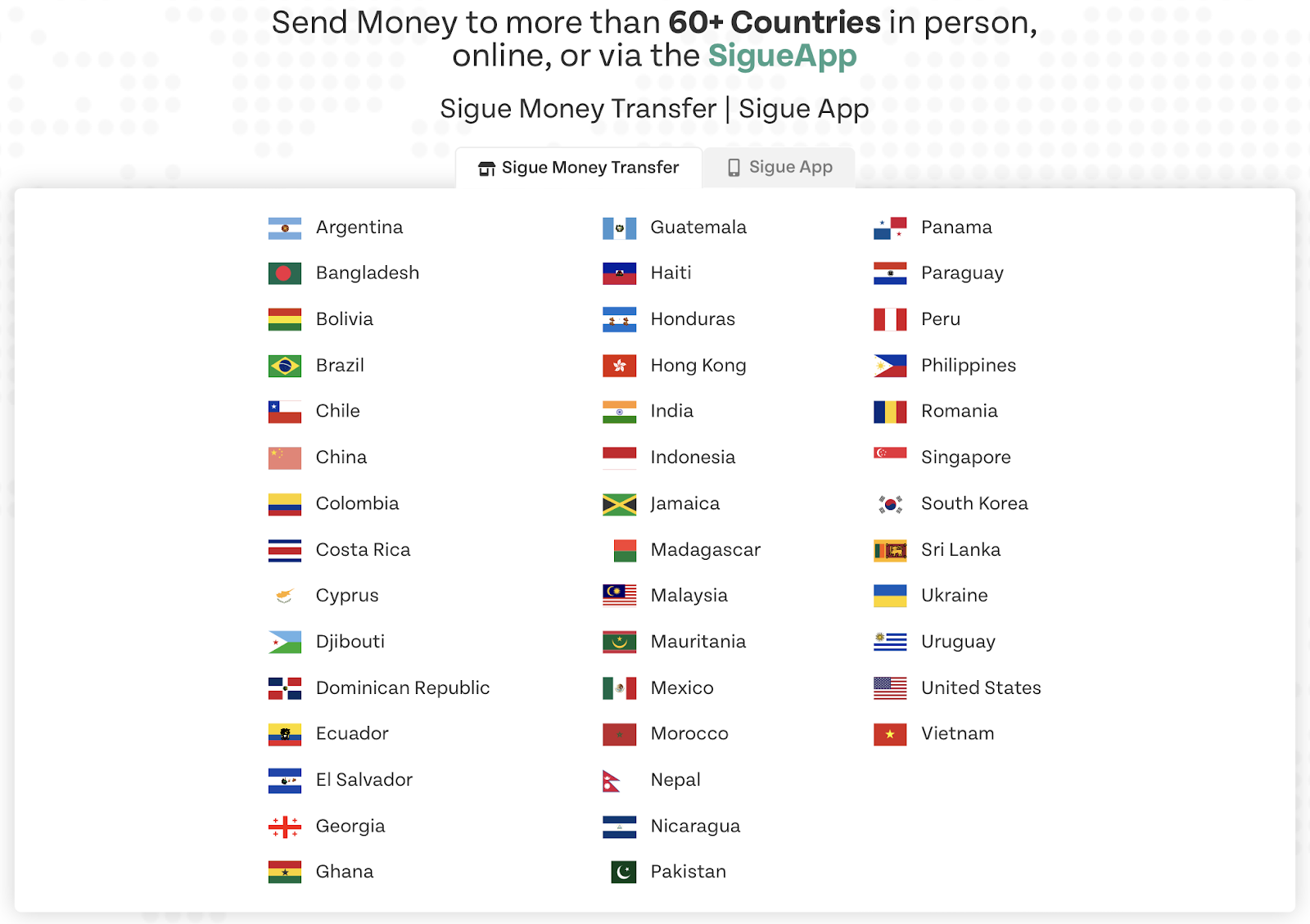
Currently, Sigue offers money transfers to over 60 countries. Countries supported by Sigue Money Transfer include: 

  • Argentina
  • Bangladesh
  • Chile
  • China
  • Ecuador
  • Ghana
  • India
  • Jamaica
  • Mexico
  • Morocco
  • Nepal
  • Pakistan
  • Philippines
  • South Korea
  • Sri Lanka
  • United States
  • And More. . . 

To view a complete list of countries that Sigue serves, navigate to the home page. From there, scroll down and click on the button that says “Select a Featured Country.” Then, click on the button that says “list of countries,” and you will be shown all the countries you can send money to! 

How Much Does Sigue Money Transfer Cost? 

The cost of using Sigue Money Transfer is a fixed fee, subject to occasional changes. Users can easily check the current transfer fee before initiating any transaction directly on the "Send Money" screen within the app.

There are no hidden fees! The fee breakdown you are given in the app is what you will pay. 

In certain transactions, the recipient might receive a reduced amount due to taxes or additional fees imposed by third parties in the destination country. These deductions will be clearly indicated on the receipt for transparency purposes.

How Much Money Can I Send Using Sigue? 

Sigue Money Transfer imposes limits on the amount one can send, you can send a maximum of 2,999 USD per day, including the sending amount along with the associated fee.

Ways to Send Money with Sigue Money Transfer

Sigue Money Transfer offers various methods for sending money, including online transfers through their website or app, and in-person transactions at their extensive network of physical locations across different countries. Users can locate these branches using the provided tool on the Sigue website under "Sigue Money Transfer locations."

How Long Does Sigue Take to Send Money? 

The time taken for a money transfer via Sigue depends on multiple factors, such as the destination country, service speed selected, and transfer method. While some transactions may occur within minutes, others might take longer due to verification processes or banking procedures.

For a more precise estimate of the processing times, check the transfer estimate you will get on the Sigue app. 

Is Sigue Safe? 

Sigue Money Transfer prioritizes the security of its users' transactions. Employing robust encryption and security measures, Sigue aims to safeguard personal and financial information, ensuring a secure money transfer experience.

How to Send Money With Sigue? 

Now for the biggest question you must have: how does Sigue work?

Luckily, using Sigue for your international money transfers is relatively straightforward. Here's a step-by-step guide:

  1. Create an Account: Visit the Sigue Money Transfer website or download the app. Create an account by providing necessary information.
  2. Initiate Transfer: Log in to your account and select the country and amount you wish to send.
  3. Recipient Details: Enter recipient details accurately.
  4. Choose Service Speed: Select the desired service speed and review the transfer details.
  5. Payment: Make payment using available options.
  6. Confirmation: Once the transaction is complete, obtain the transaction reference number for tracking purposes.

Sigue provides a tracking feature that allows you to monitor the status of your transfer in real-time either from the Sigue homepage, Sigue app, or your online login. You'll receive notifications when the money is sent and when it's received by the recipient.

How to Contact Sigue? 

Sigue Money Transfer provides comprehensive customer support through various channels. Users can access assistance by visiting the "Knowledge Center" on the Sigue website, which offers detailed information and FAQs. You can use their chat feature to chat with a live agent and ask your questions. 

Still need help? Contact their customer service using this number: 1-877-754-9777

Pros of Sigue Money Transfer

Based on our research of customer reviews and comparison to other remittance providers, the pros of the Sigue money transfer service are:

  • Multiple Money Transfer Options: Sigue Money Transfer provides various transfer methods, including access to cash payments and physical locations, offering convenience and accessibility to users who prefer in-person transactions. This flexibility caters to diverse user preferences and needs.
  • Live Chat Support: Sigue offers a customer service feature that allows users to chat with an agent for assistance. This real-time support distinguishes Sigue from many competitors who may not provide such immediate and direct communication channels, enhancing customer service experience.
  • Multilingual Customer Support: Sigue offers customer support in multiple languages, ensuring that users from different regions can access assistance in their preferred language.
  • Convenient Mobile App: Sigue provides a user-friendly mobile app that enables easy and convenient money transfers on-the-go, enhancing accessibility and usability for customers.
  • Responsive Customer Service: Sigue offers customer support through various channels, including phone, email, and live chat, providing timely assistance and support to users.

Cons of Sigue Money Transfer Service

Based on our research of customer reviews and comparison to other remittance providers, the cons of the Sigue service are:

  • Limited Availability: Sigue may not be available in all countries. Users should check if the service operates in their region before attempting to sign up.
  • Transfer Limits: Sigue Money Transfer imposes limitations on the amount of money that can be sent, which might inconvenience users looking to send larger sums of money.
  • Limited Transparency on Fees: Users might find it challenging to access comprehensive information about fees and exchange rates without initiating the transfer process or creating an account, which could be inconvenient for some.
  • Absence of Transfer Calculator: Unlike some competitors, Sigue does not offer a money transfer calculator tool on their website, which could be a drawback for users who prefer to calculate costs and exchange rates beforehand.

Sigue Money Transfer Service: Best Feature

Sigue Money Transfer distinguishes itself notably through its extensive network of physical branches, a standout feature that sets it apart from many competitors in the money transfer industry. Unlike several other services that primarily operate online or through limited partner locations, Sigue offers customers the convenience of accessing cash payment options and physical locations across various countries. These physical branches facilitate in-person transactions, catering to individuals who prefer or require the immediacy and assurance of face-to-face interactions when sending or receiving money. This accessibility to physical branches and cash payment options adds a layer of convenience and flexibility for users, underscoring Sigue's commitment to providing diverse and accessible avenues for international money transfers. 

Sigue Money Transfer Service Alternatives

If you’re looking for an alternative to Sigue’s remittance service, here are some top remittance providers we recommend that offers low fees, excellent exchange rates, and are easy to use: 

Sigue Reviews

Need more assurance about Sigue? Let’s see what users of Sigue have to say. Sourced from multiple platforms, customer reviews of Sigue are: 

“The app is very easy and straight forward to use. There are no gimics or application issues. Just good business at a very fair price. The first transfers take some time maybe half a day. After their system is familiar with your account it's much faster, in a matter of hours!!” - Salim McNeely on GooglePlay

“I love how easy it is to send money to anyone in my country of Mexico. Sometimes I enjoy coupon discounts for every time I send money, which is convenient as I send to multiple people in my family. I also like that it shows me how much the exchange is for the various banks and or cash pick up participating stores.” - User on Apple App Store 

Negative reviews pertain to app crashes and difficulty with the user interface. 

Do We Recommend Sigue?

Sigue Money Transfer emerges as a reliable and accessible platform for cross-border money transfers. With its robust security measures, diverse transfer methods, and extensive global network, Sigue provides a viable solution for individuals and businesses seeking efficient money transfer services across various countries.

We invite you to compare remittance providers using CompareRemit’s comparison tool today to find the best rates, lowest fees, and fastest turnaround times for your specific destination and transfer amount.

 6093 views
Rate article:
(0.0)
 
 
Money Transfer FAQ's
Related Articles
Portfolio Investment Scheme
Portfolio Investment Scheme: An NRI Guide for 2026

As a non-resident Indian (NRI) or overseas citizen of India (OCI), investing in India’s dynamic stock market can help you grow your wealth while staying connected to your roots.In 2024, the BSE Sensex delivered an impressive 8.2% return, marking its ninth consecutive year of gains. The Portfolio Investment Scheme (PIS) offers a regulated and streamlined route for NRIs to invest in Indian equities and securities.This guide explains the meaning, mechanics, eligibility criteria, and application process of the Portfolio Investment Scheme. See how the PIS is connected to remittances and how CompareRemit’s exchange rate calculator can help you maximize every dollar you send to fund your investments.What is the Portfolio Investment Scheme? The Portfolio Investment Scheme, overseen by the Reserve Bank of India (RBI), enables NRIs and OCIs to invest in the Indian stock markets through a structured framework. Launched in 1992, PIS enables you to buy and sell equity shares, convertible debentures, and other securities listed on recognized exchanges, such as the BSE and NSE. The scheme was introduced to attract foreign investment while ensuring transparency and regulatory control.By routing investments through designated bank accounts, the RBI monitors transactions and facilitates compliance. For NRIs, PIS provides a secure way to tap into India’s growing economy.Now that you understand the basics, let’s explore how PIS functions in practice.How Does the Portfolio Investment Scheme Work?The PIS operates through a clear, regulated process:Designated bank accounts: Investments must flow through NRE (Non-Resident External) or NRO (Non-Resident Ordinary) accounts with an RBI-authorised bank.Transaction tracking: All PIS transactions are reported to the RBI for compliance with FEMA regulations.Repatriation: NRE-linked accounts permit full repatriation of funds, whereas NRO accounts are subject to restrictions.Here's an example of how it would work:To buy shares of Tata Motors, you transfer USD to your NRE account using a money transfer service and convert it to INR. You then instruct your bank to execute the purchase via your linked demat and trading accounts.To fund your PIS account efficiently, use CompareRemit’s comparison tool and find the best USD to INR exchange rates. How Does the Portfolio Investment Scheme Work?PIS outlines who can invest, the types of assets permitted, and the regulatory framework governing these transactions. Here's a breakdown of how it functions, from eligible participants to RBI compliance rules:Eligible investors: Only NRIs and OCIs can participate; resident Indians and non-OCI foreign nationals are excluded.Permissible investments: Equity shares, convertible debentures, and securities listed on BSE or NSE.Prohibited sectors: Investments in real estate, chit funds, or Nidhi companies are restricted, with sectoral caps (e.g., 10% for banking).RBI guidelines and compliance: The Reserve Bank of India regularly updates its operational guidelines for PIS. These cover investment limits, reporting requirements, and account operations. All investments must be routed through designated banks and brokers registered with the stock exchanges.How to Apply for the Portfolio Investment SchemeGetting started with the PIS is a fairly simple process, but it does involve a few key steps and documents. Here's how to apply and get your account set up:Choose a designated bank: Select an RBI-authorized bank, such as HDFC, ICICI, or SBI, that offers PIS services.Open NRE/NRO account: Link an NRE or NRO account to your PIS application.Submit PIS application: Complete the bank’s PIS form, available online or at branches.Provide KYC documents: Submit your passport, visa, PAN card, and overseas address proof.Link your demat and trading accounts: Connect your PIS account to a demat and trading account with a registered broker.Approval timeline: Expect approval within 7-10 business days.Once approved, you’ll need to decide between picking an NRE and or an NRO account for your investments.NRE vs. NRO Accounts Under PISChoosing the right account type is critical for PIS. Here’s a comparison between NRE and NRO accounts so that you can pick the right one for your needs:FeatureNRE accountNRO accountRepatriabilityFully repatriable (principal and profits)Restricted; requires RBI approvalTaxationInterest is tax-freeInterest taxable (up to 30%)Investment ScopeEquity, debentures, and mutual fundsSame as NRE accounts, with repatriation limitsBest ForLong-term investors seeking repatriationInvestors with Indian incomeMany NRIs prefer using NRE accounts for their repatriation benefits, especially for equity investments. Explore CompareRemit’s NRI services to compare top Indian banks offering NRE and NRO accounts, view account types, contact details, required documents, and apply seamlessly in one place.Now, with the account choice clear, let’s look at why PIS is appealing to NRIs.Benefits of the Portfolio Investment Scheme for NRIsPIS offers several advantages for global Indians:Seamless market access: Invest directly in India’s stock market without intermediaries.RBI oversight: Ensure transparency and FEMA compliance.Tax clarity: Enjoy tax-free interest with NRE-linked accountsRepatriation flexibility: Get easy fund repatriation with NRE accountsWhile PIS has clear advantages, it’s also important to understand its limitations.Limitations and Important GuidelinesPIS comes with specific rules for NRIs that you must keep in mind:Investment limitsNRIs and OCIs can hold up to five percent of a company’s paid-up equity capital. The total cap across all NRI and OCI investors in a single company is 10 percent, extendable up to 24 percent or the sectoral FDI limit, with board and regulatory approval.No intraday tradingPIS does not allow intraday trades. All equity trades must be settled on a delivery basis. You must hold shares for at least one day before selling. Short selling and derivatives trading are not permitted.Brokerage and bank chargesBanks typically charge a one-time PIS account setup fee (around ₹1,000) and annual maintenance fees (from ₹500 to ₹1,000). Each buy or sell transaction reported to the RBI attracts a processing fee (usually ₹100 to ₹200), in addition to standard brokerage (often capped at 0.5 percent or a flat rate). Demat and trading account charges may apply based on your broker’s policy.RBI monitoringAll PIS transactions are reported to the RBI by the designated banks. The RBI monitors compliance with sectoral limits and FEMA rules. If limits are breached, corrective actions may follow. Following these rules helps you invest transparently and stay compliant with Indian regulations under the PIS.PIS and Remittances: What You Should KnowFunding your PIS account efficiently can boost your investment returns. Exchange rate fluctuations, such as those influenced by global trade policies, demonstrate how the USD to INR currency trends affect remittances. For NRIs, timing INR transfers is crucial:Optimize currency conversion: Use CompareRemit’s rate comparison tool to find the best USD to INR rates. The INR is trading at ₹86.35 against USD as of July 22, 2025.Avoid double conversion fees: Transfer directly to your NRE account to minimize costs.Track exchange rates: Set alerts on CompareRemit to catch favorable rates, as INR has fluctuated between ₹84.22 and ₹87.79 against USD in 2025.Many more remittance providers offer competitive rates and fast transfers. Check reviews of remittance companies on CompareRemit to find the best fit for your PIS funding needs. With a clear remittance strategy, let’s wrap up with how to make the most of PIS.Maximize Investment, Minimize HassleThe Portfolio Investment Scheme for NRIs empowers you to invest in India’s thriving stock market with confidence and transparency. By understanding what the Portfolio Investment Scheme is, how it works, and its eligibility criteria, you can make informed decisions to grow your wealth.Pairing PIS with smart remittance planning ensures your money goes further. For instance, sending $1,000 at 83 INR/USD yields 83,000 INR, but at 84 INR/USD, you get 84,000 INR. It's a 1,000 INR difference that adds up.To maximize your investments, use CompareRemit’s tools to compare exchange rates, fees, and transfer times.Select low-fee services, such as mobile wallets or bank transfers, to efficiently fund your PIS account. With the right approach, your hard-earned money can achieve maximum impact in India’s stock market.Frequently Asked Questions (FAQs)Q: What is the meaning of the Portfolio Investment Scheme for NRIs?PIS enables NRIs and OCIs to invest in Indian stock markets through RBI-regulated NRE/NRO accounts, ensuring transparency and compliance.Q: How do I apply for the Portfolio Investment Scheme in 2025?Open an NRE/NRO account with an RBI-authorized bank, submit the PIS application with KYC documents, and link your demat/trading account. Approval usually takes 7–10 days.Q: Can I invest through both NRE and NRO accounts under PIS?Yes, NRE accounts offer full repatriation of funds, while NRO accounts have restrictions on repatriation; choose based on your specific needs.Q: Are intraday trades allowed under the PIS?No, intraday trading is prohibited; shares must be held for at least one day under PIS rules.Q: How does PIS differ from other NRI investment routes?PIS is for stock market investments under RBI oversight, unlike FDI or mutual funds, which follow different regulations.Q: How can I get the best exchange rate when remitting funds for PIS?To maximize your investment value, it’s essential to compare exchange rates and transfer fees before sending money. CompareRemit lets you compare real-time exchange rates and fees across leading money transfer services so you get the most out of every dollar you send to fund your PIS investments.

State taxes
9 US States with No Income Tax: What You Need to Consider

If you're looking to keep more of what you earn, relocating to a state without taxes in the USA might sound like the dream move. For immigrants and small business owners sending money internationally, every saved dollar can go a long way. But while avoiding state income tax is appealing, there's more to it than what meets the eye.In 2025, nine US states don’t levy a personal income tax, but that doesn’t necessarily mean they are cheaper than other places to live. This article unpacks what you need to know about states with no income tax in the USA, what trade-offs to expect, and how to determine if such a move aligns with your financial goals.Let’s dive into the details so you can make calculated decisions, especially if you are planning a long-term stay in the US or thinking about where your money works hardest.The 9 US States With No Personal Income TaxThese nine states currently do not collect personal income tax:AlaskaFloridaNevadaNew HampshireSouth DakotaTennesseeTexasWashingtonWyomingHere’s a closer look at each state and what you need to consider beyond just the 'no tax' label:1. AlaskaNo state income tax. No state sales tax. Sounds perfect, right?Alaska’s tax-free appeal is strong. It doesn't charge state income or sales tax, making it a tax haven for some. However, the cost of living is high due to its remote geography. Groceries, utilities, and housing can be on the expensive side.State Revenue Sources:Alaska relies heavily on revenue from oil production and royalties rather than taxing residents directly.2. FloridaFlorida is a magnet for retirees and remote workers alike. With no personal income tax and a fairly average 6% state sales tax, it offers sunshine and tax relief.What You Should Know:While it saves you on income tax, Florida does have high property insurance premiums and a higher-than-average cost of living in cities like Miami and Orlando.3. NevadaHome to Las Vegas, Nevada, offers zero state income tax but applies a state sales tax of 6.85% (with combined rates often topping 8%).Key Trade-Off:Nevada's revenue comes from tourism, gaming, and sales taxes. It's a good option for those with higher incomes or retirees, but property values and insurance costs are higher than the national average.4. New HampshireNew Hampshire is unique. While it’s considered a state without taxes in the USA, it still taxes dividends and interest. However, that’s being phased out by 1% annually and will be fully done with by 2027.Other Considerations:It has no sales tax but one of the highest property tax rates in the country. That’s something to factor in if you plan to buy a home.5. South DakotaSouth Dakota offers a highly business-friendly environment, being among the US states with no corporate income tax. It has no state income tax and is a top choice for small business owners across the U.S.How It Makes Up:It generates revenue through sales taxes, tourism (Mount Rushmore!), and excise taxes. The cost of living is relatively affordable compared to other no-tax states.6. TennesseeTennessee used to tax investment income, but that changed in 2021. Today, there’s no personal income tax at all.What's the Catch?It has the highest combined sales tax rate in the country at 9.55%. If you are a big spender, that might outweigh income tax savings over time.7. TexasTexas may be an income tax-free state, but it compensates with high property taxes; in fact, it has some of the highest in the country.Things to Note:It’s great for high earners and entrepreneurs, but housing and insurance costs can vary widely depending on the region.8. WashingtonWashington has no personal income tax but does impose a capital gains tax on some high-income earners.Where the Money Comes From:Gas taxes are among the highest in the U.S. at 49.4 cents per gallon. Also, be prepared for high housing costs in cities like Seattle.9. WyomingWyoming combines no income tax with low sales and property taxes, making it one of the most tax-friendly states overall.State Revenue:It earns much of its revenue through taxes on natural resource extraction, especially coal and oil.Does Living in a Tax-Free State Save You Money?Not always. While there may be no tax in the U.S.A. states mentioned above, they still need money to run public services. Therefore, the states find alternate ways to collect some form of tax.Here are some key factors to look out for:Sales tax rates can significantly increase your cost of living.Property taxes can offset income tax savings, especially if you are a homeowner.Healthcare, education, and public services might not be as well-funded in some no-tax states.Consider Your Entire Tax BurdenWhen evaluating states with no income tax in the U.S., consider the overall tax burden, the percentage of personal income residents pay in all state and local taxes.For example:According to some reports, Alaska has the lowest overall tax burden at 4.93% of personal income. Meanwhile, Nevada has the highest burden among no-income-tax states at 8.62%.Your actual savings depend on your lifestyle. If you rent and spend less on taxable goods, sales and property taxes may not affect you much. But if you're a homeowner with high expenses, the savings might not be as high as you would imagine.Earning Income Across State Lines? Here’s What You Should KnowLet’s say you live in Texas (a tax-free state) but earn freelance income from New York. You may still need to file a non-resident income tax return in New York.Similarly, if you live in a state that taxes income but earn money in a tax-free state, you will likely report that income on your home state's return.This is especially important for gig workers, remote employees, and small business owners managing income from multiple locations.Making Smart Financial ChoicesChoosing to live in a state without taxes may lower your tax bill, but it shouldn't be your only deciding factor. Think about:Your family’s needsAccess to quality healthcare and educationJob market opportunitiesYour money transfer needs if you regularly send funds abroadReady to Maximize Your Savings?Living in a tax-free state can stretch your income further, but it’s only part of the puzzle. If you're sending money to family in Mexico, India, or the Philippines, you also want to ensure you send back as much as you possibly can.With CompareRemit’s exchange rate comparison tool, you can find the best rates and lowest fees from trusted remittance providers, all in one place. Save on taxes and international transfer fees with smart financial planning.Frequently Asked Questions (FAQs)Q: What states have the highest taxes in the U.S.?States like California, New York, and New Jersey are often ranked among the worst due to high overall tax burdens, including income, property, and sales taxes. Compared to states without taxes, these have significantly higher costs, making states with no income tax more attractive for many.Q: Do I have to pay income tax if I work in another state?Yes, if you live in a state without taxes in the U.S. but earn income in a state that imposes income tax, you will likely need to file a non-resident tax return in that state. This is common even for those living in U.S. states with no personal income tax.Q: Are there states in the U.S. with no income tax and no sales tax?Alaska is the only state in the U.S. that has neither a state income tax nor a statewide sales tax.Q: Is Washington going to have an income tax?As of 2025, Washington remains a state without taxes in the U.S. on personal income. However, recent legislative proposals have introduced discussions around new taxes targeting the ultra-wealthy, such as a 1% wealth tax on assets exceeding $100 million. While these measures are under consideration, no personal income tax has been implemented, keeping Washington among the US states with no personal income tax.Q: Do we save more in a no-tax state compared to one where tax is applicable?Not necessarily. Other factors, such as the cost of living, play a crucial role in determining how much you get to save.

dollar-to-php-exchange-rate-today
Dollar to PHP Rate Today for Remittances

In the Philippines, remittances are lifelines for millions of families. Every dollar sent helps cover essentials like household expenses, school fees, business needs, or unexpected emergencies. Understandably, then, even slight shifts in the exchange rate can make a significant difference for Overseas Filipino Workers (OFWs) and others sending money back home.In this comprehensive guide, we cover everything from the US dollar to the PHP peso exchange rate today, to why rates fluctuate, and how you can make the most of your remittances.US Dollar to PHP Peso Exchange Rate TodayThe US Dollar to PHP Peso exchange rate today is approximately PHP 55.85 per $1 USD. For the most accurate and up-to-date rates, please visit the Bangko Sentral ng Pilipinas (BSP) website.Why Don’t You Always Get the Rate You See?While the BSP’s official rate provides a good reference point, most remittance services and currency exchange platforms don’t offer that exact rate to consumers. Instead, they apply a markup. This means that the rate you get is slightly lower than the one you see.For instance, if the mid-market rate is PHP 56 per $1, a remittance provider might offer you only PHP 55.20 or even PHP 55, depending on their profit margins. Additionally, many also charge a separate transfer fee, which further reduces the amount your recipient ultimately receives.Understanding the Mid-Market RateThe mid-market rate, also known as the interbank rate, is the rate at which banks and financial institutions exchange currencies with one another. It's considered the "real" exchange rate, but it's not typically what consumers get.Here's where platforms like CompareRemit become incredibly useful. They show current dollar exchange to Philippine peso rates as well as transfer fees from multiple providers side by side. Viewing these together helps you choose the most cost-effective option for sending money to the Philippines.USD to PHP Exchange Rate History (2024)The year 2024 began with the US dollar trading at around PHP 55.80. Over the course of the year, the peso weakened, and the exchange rate peaked at PHP 59.435 on December 18, 2024. That’s roughly a 6% to 7% increase, highlighting how currency fluctuations can significantly impact remittances and import costs.How Are Things Looking in 2025?As of June 2025, the USD to PHP exchange rate stands at approximately PHP 55.68. The highest rate so far this year was PHP 59.009 on January 10, while the lowest was PHP 55.350 on May 25. This shows some volatility. But overall, the peso has regained some strength since the start of the year.USD to PHP Outlook: What to Expect Next?Forecasts for the USD to PHP exchange rate over the next year vary widely. Some analysts expect the peso to strengthen, potentially pushing the rate closer to PHP 48.86 by mid-2026. Others anticipate it hovering around PHP 58.69 by the end of 2029, pointing to long-term depreciation.Highest Dollar Exchange Rate to PesoThe highest dollar exchange rate to peso was recorded in December 2024, when the Philippine peso dropped to approximately 59–60 PHP per US dollar. This spike was driven by factors such as uncertainty around the US presidential election and interest rate policies from the US Federal Reserve. Additional factors included the Bangko Sentral ng Pilipinas’ interest rate cuts and rising inflation expectations in the Philippines. Global geopolitical tensions also boosted demand for the dollar, further weakening the peso.When is the Best Time to Send Money to the Philippines?In general, it's best to send money when the peso is weak against the dollar. This will give you a higher dollar-to-peso PHP exchange rate and allow your recipient to receive more pesos for every dollar you send. So, weakening of the peso works in favor of Filipinos working in the US.Remember, keeping an eye on these trends and using comparison platforms like CompareRemit can help you time your transfer smartly and maximize its value.Practical Tips to Get the Best Exchange Rate When Sending Money to the Philippines1. Compare money transfer service providersDon’t rely on a single provider every time. Use CompareRemit to evaluate different money transfer services. With it, you can instantly check:Real-time dollar to peso PHP exchange rate todayThe best transfer feesFastest transfer speedsCompareRemit even lets you compare transfer services in tabular format. Click on “FIND THE BEST RATES,” select the service, and choose compare.2. Look for a locked-in exchange rateSome providers allow you to lock in the exchange rate at the time of the transaction. This protects you from rate drops and ensures your recipient gets the expected amount, even if the transfer takes a few hours or days to complete.3. Time your transfers strategically The US Federal Reserve and geopolitical events influence interest rates. These include elections and conflicts, and can significantly affect the US dollar to PHP peso exchange rate. Use CompareRemit to monitor rates, as well as the best timing for your transfers. 4. Adjust your strategy for small vs. large transfersFor smaller amounts, aim for low or zero transfer fees. For larger transfers, prioritizing a competitive exchange rate is important, as it can help you save thousands of pesos.  5. Check for full creditSome platforms may offer zero fees but may deduct some amount from what you're sending. Confirm all charges beforehand so that your recipient gets the full credit. 6. Avoid weekend transfers Foreign exchange markets are closed on weekends. Unless it is very urgent, avoid sending any money during weekends.7. Choose the right payment methodPaying via bank transfer or Automated Clearing House (ACH) is often more cost-effective than using a credit or debit card, which may incur additional processing fees.  How to Use the CompareRemit Platform and App for Remittances?You can visit the CompareRemit website directly to find money transfer service providers and compare them on various fronts. If you prefer using your smartphone for easy access, download the CompareRemit app from the Google Play Store or the App Store. After setting up your profile: Go to the USD to PHP rate comparison page.Confirm USD as the sending currency and the Philippines as the receiving country.Enter the amount you wish to send.Click on "FIND THE BEST RATE".Instantly view multiple providers and compare their rates, transfer fees, transfer time, and final PHP received.Select the best option you find fit and click on "Learn More" to continue your transfer on the provider's website.Once you have done your due diligence and chosen a service provider on CompareRemit, you can proceed with the money transfer process. Here's how:Register an account with your selected service.Provide ID and address proof for verification.Add your preferred payment method.Enter your recipient’s details.Select how the money should be delivered (e.g., bank deposit or cash pickup).Enter the transfer amount and confirm the transaction.Make the payment using your preferred method.You’ll receive a confirmation once the transfer is complete.Send USD to PHP With ConfidenceAs you plan your next transfer to your recipients in the Philippines, consider the current dollar exchange rate to the Philippine peso and decide what factors are most important to you: speed, the most value for money, or the least amount of fees.Don’t forget to use the CompareRemit calculator to simplify your remittance process; get access to transparency and peace of mind for your hard-earned money.Frequently Asked Questions (FAQs)Q: How do I know if I am getting a good USD to PHP exchange rate when sending money?You can check the mid-market rate on Google or financial websites like XE or Bloomberg, then compare it to what your remittance service is offering. If the gap is significant, you might not be getting the best deal.Q: Is it better to send money through a bank or a money transfer service?Bank transfers are safe and secure, but can be slow and may offer less favorable exchange rates or higher fees. Money transfer services, on the other hand, often provide faster delivery, better rates, and more options, such as cash pickup or mobile wallet transfers. This makes them a more cost-effective choice for many senders.Q: What additional charges should I watch out for when transferring money internationally?Beyond the transfer fee, be aware of exchange rate markups, receiver-side bank fees, or service charges for specific payment methods, such as credit cards. Q: Is it better to send money directly to a bank account or for cash pickup in the Philippines?Bank account deposits are usually cheaper and more secure for recurring transfers or larger amounts. Cash pickups are useful when recipients lack access to a bank, need money urgently, or reside in rural areas. However, cash pickup services might charge more or offer slightly lower exchange rates.Q: Do remittances from the US to the Philippines get taxed?Generally, personal remittances sent to family members in the Philippines are exempt from tax. However, large transfers, business-related payments, or frequent high-value remittances may invite scrutiny and taxes under local or international laws.Q: What happens if the exchange rate drops after I initiate a transfer?If your remittance provider doesn't offer a locked-in rate, the amount your recipient gets may be lower if the exchange rate falls before the transfer is processed. Choose services that allow rate locking, which ensures the agreed-upon rate holds even if there are fluctuations during the transfer time.

Download the CompareRemit App
Personalize your CompareRemit experience with your preferred corridor and receive target exchange rate notifications, seamless transitions to partner apps, and real-time comparisons of top remittance providers at your fingertips.

Get Listed or Advertise

Download Our Free App

Try our faster, enhanced mobile app for a better experience

CompareRemit App